The Archivist’s Nook: 250 Years of American History through Six Objects

Like many cultural heritage institutions across the United States, we have been eagerly anticipating this year’s 250th anniversary of American independence. We have prepared articles, exhibits, and planned our personal holiday celebrations. But before we part ways for the long holiday weekend and head to our various parades or barbecues, we wish to give a brief reflection on American history as told through six objects from our collections. Each member of the Special Collections selected one item from the collections to highlight an aspect of American history.

This slideshow requires JavaScript.

Romantic Portrayals of the American Landscape
selected by Shane MacDonald, Curator of Digital & Museum Collections

Heinrich Vianden (NMC 1165)

Heinrich Vianden (1814-1899), a German-born American artist who settled in Wisconsin in 1849, one year after the state entered the union. Influenced by the Romantic movement of the age, his paintings reflected the landscape of his new country. He trained generations of American artists from his school near Milwaukee. Among his interests was painting the Wisconsin Dells, a natural site in the state that was becoming a destination in the latter half of the nineteenth century.

This style of painting may invoke the Hudson River School, a Romantic movement primarily focused on landscape painting in the nineteenth century, capturing the scenic beauty of the American continent. While Vianden is not a direct member of this group, he nevertheless demonstrates the richness of the art movement in the first American century and its shaping of subsequent art. An immigrant to the United States and an artist, Vianden’s painting invokes a love for the natural beauty of his adopted land.

The Fourth of July Fondly Recalled
selected by Alexis Howlett, Special Collections Technician

W. J. Howlett

W. J. Howlett (1847-1936), an Irish immigrant priest and author. Traveling across the Western United States before settling in Kentucky, he composed an autobiographical manuscript in his eighty-seventh year of life. Throughout the work, he “necessarily looks backward in his spare moments” (Howlett Memoirs, 7). This distance, Howlett says, may heighten the enchantment or exaggerate the view of little nothings; but, he takes pleasure and finds amusement in looking back over the disappearing vista of his life. Recounting the flurry of memories from his childhood into his older age, he recalls a timeless experience of the Fourth of July as he experienced it as a young boy growing up in Kentucky ca. 1860.

We were patriots also. The Fourth of July always found us ready with flags, firecrackers, toy cannons to show our American spirit, but I guess it was rather to have a good time at some of the lakes fishing and swimming and making up some picnic party. The more serious part of the program was left to older heads, and there was no lack of zeal among them in making the whole affair a success as planned. (Howlett Memoirs, 26)

He concludes the passage recognizing that, as a young man, he found the fun of the day more interesting than its history.

Volunteerism in Times of War and National Crisis

A National Catholic War Council Poster.

W. J. Shepherd, University Archivist and Head of Special Collections, has worked with hundreds of archival collections and thousands of documents, books, photographs, and other material items for more than three decades in CatholicU’s Special Collections. Selecting a favorite to honor the nation’s 250th anniversary is no easy task. However, he chose a colorful World War I poster titled ‘See Him Through -Help Us To Help The Boys,’ created jointly in late 1918 by the Knights of Columbus and the National Catholic War’s Council (NCWC), known in the twenty-first century as the United States Conference of Catholic Bishops (USCCB).

The poster was one of many as part of a one-week fundraising effort, the United War Work Campaign of November 11-18, requested by President Woodrow Wilson to seven voluntary American religious organizations, including the Knights, NCWC Salvation Army, Jewish Welfare Board, YMCA, YWCA, and the American Library Association (ALA) to boost the morale of soldiers and war workers via recreational activities. It successfully raised over $200 million, the 2026 equivalent of over $4 billion! The NCWC records, held by Special Collections, are among its most significant and highly used holdings and a particular focus of Mr. Shepherd’s work throughout his career.

Service in War and Peace
selected by Abigiail Hibbs, Graduate Library Pre-professional

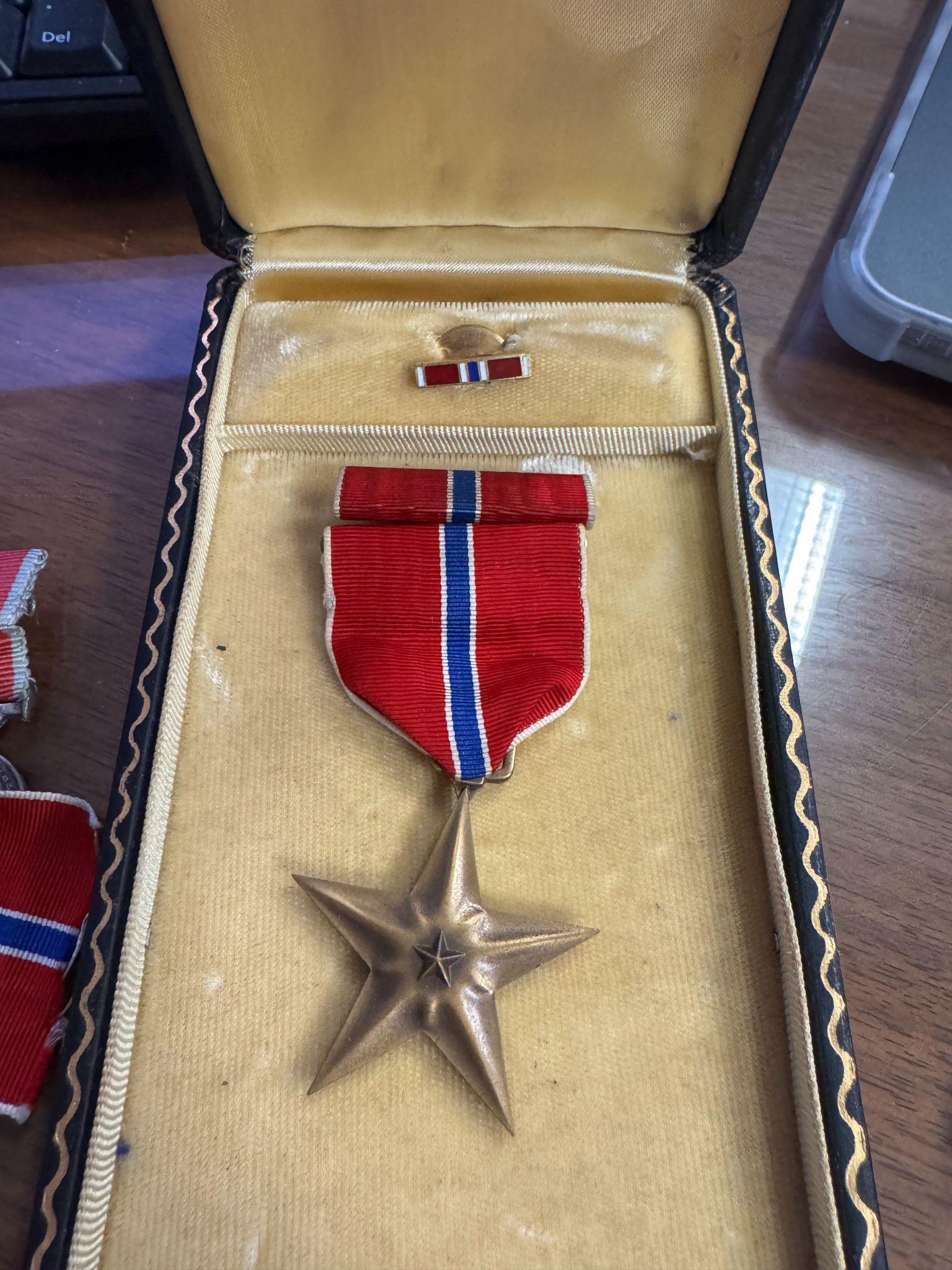
Bronze Star, World War II

The Bronze Star is awarded for heroic or meritorious achievement or service in the armed forces. It was first awarded during World War II and is one of the highest military honors. This Bronze Star was awarded to Bernard Mann Peebles who served in the U.S. Army during WWII. This subcommittee also known as the Monuments Men, were tasked with recovering, inventorying and investigating cultural artifacts damaged or stolen from Italy during the war.

Later Peebles was a professor of Greek and Latin at Catholic University where his personal papers are now held. He used his expertise to develop much to the University’s Rare Books library over his tenure.

Forming a Catholic American Identity

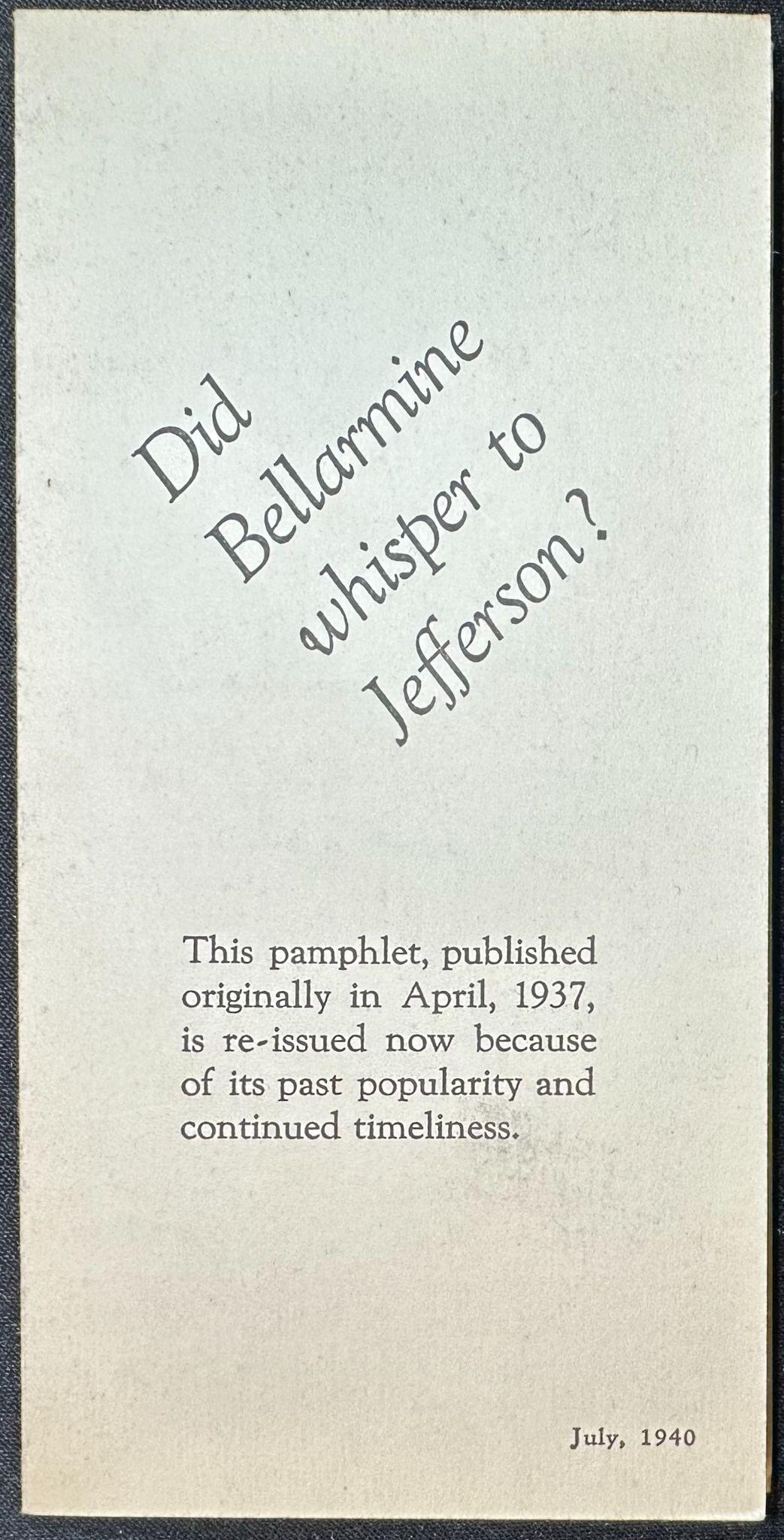
Did Bellarmine whisper to Jefferson?, 1940

Sally Kendrick, Rare Books Librarian, highlights a pamphlet entitled “Did Bellarmine Whisper to Jefferson?”, published in 1940 by the Catholic Information Society. The author points to similarities between the writings of St. Robert Bellarmine (1542-1621) and the text of the Declaration of Independence, commenting, “we wonder, we Catholics, whether at least a whisper from the great theologian did not reach the ear of the great statesman.” This is not the first suggestion of such a connection. Historian Gaillard Hunt published on the topic in the Catholic Historical Review in 1917, but the theory of a clear line of transmission connecting Jefferson to Bellarmine did not meet with widespread scholarly acceptance.

Ultimately, this pamphlet says more about 1940 than it does about 1776. By the early 20th century, American Catholics had experienced generations of widespread anti-Catholic sentiment. The Bellarmine-Jefferson connection thus gained popularity among them as an indication that their identities as Catholics and as Americans were not in competition and that the highest American ideals were, in fact, Catholic in origin. Although the specific historical argument it makes regarding Bellarmine is not now commonly believed, this pamphlet represents a step along the path of Catholic identity-making in America.

Finding Common Ground in a Democracy
selected by Darren Stephens, Special Collections Assistant

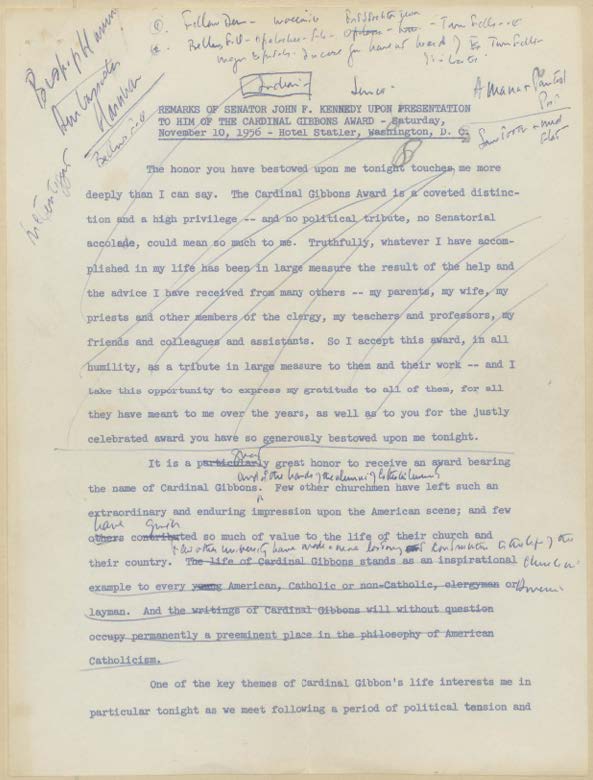
First page of JFK’s remarks, with handwritten notes, on November 10, 1956, at the Statler Hotel in Washington D.C., on the occasion of his acceptance of the James Cardinal Gibbons Award. Physical copy held at the CUA Archives; digital copy available in CUA’s digital collections.

On November 10, 1956, 39-year-old Massachusetts Senator John F. Kennedy stood at the Statler Hotel in Washington, D.C., to receive the Catholic University of America’s James Cardinal Gibbons Medal, the highest honor conferred by the university. While this was a night of personal recognition for the man who had narrowly lost the vice-presidential nomination at the Democratic National Convention in August, it served as a powerful platform to articulate his vision for American politics. Having already built a resume that included naval heroism and a successful congressional career, Kennedy used his acceptance speech to invoke the legacy of Cardinal Gibbons, a figure whom in many ways Kennedy emulated, praising the late Cardinal as a “mediator and conciliator” who worked to integrate Catholics into American life, opposed the idea of a hyphenated American, and thrust himself into the contentious issues of his time in search of solutions, all the while never compromising his or the Church’s principles or wavering in his affability. (“Remarks of Senator John F. Kennedy upon presentation to him of the Cardinal Gibbons Award,” November 10, 1956, Kennedy Folder, Small Collections, Catholic University of America Archives.)

Speaking just days after the 1956 election, Kennedy also delivered a prescient message about the dangers of political polarization, advocating for “a spirit of dissent and constructive criticism that is consistent with a spirit of national unity…and political partisanship that is consistent with the national good.” He warned against the “amateur political scientists” who sought to divide the nation into rigid liberal and conservative camps, fearing it would create a dangerous religious fervor in politics. Decades before the current era of intense partisanship, Kennedy argued that bipartisan cooperation was essential for the national interest, particularly with regard to foreign policy amidst the Cold War and the escalating Vietnam War, and that the two-party system at the time, with its “mixed views,” served as a vital check on extremism. This address was a formative moment, where he publicly honed the themes of national unity over narrow interests that would come to define his iconic presidency, the first of a Roman Catholic, four years later. (“Remarks of Senator John F. Kennedy at the Cardinal Gibbons Award Dinner,” November 10, 1956, Speech Files, 1953-1960, Speeches and the Press, Senate Files, Pre-Presidential Papers, Papers of John F. Kennedy, John F. Kennedy Presidential Library and Museum, JFKSEN-0896-009.)

The Archivist’s Nook: Title-Pages Through Time – A History of One Page

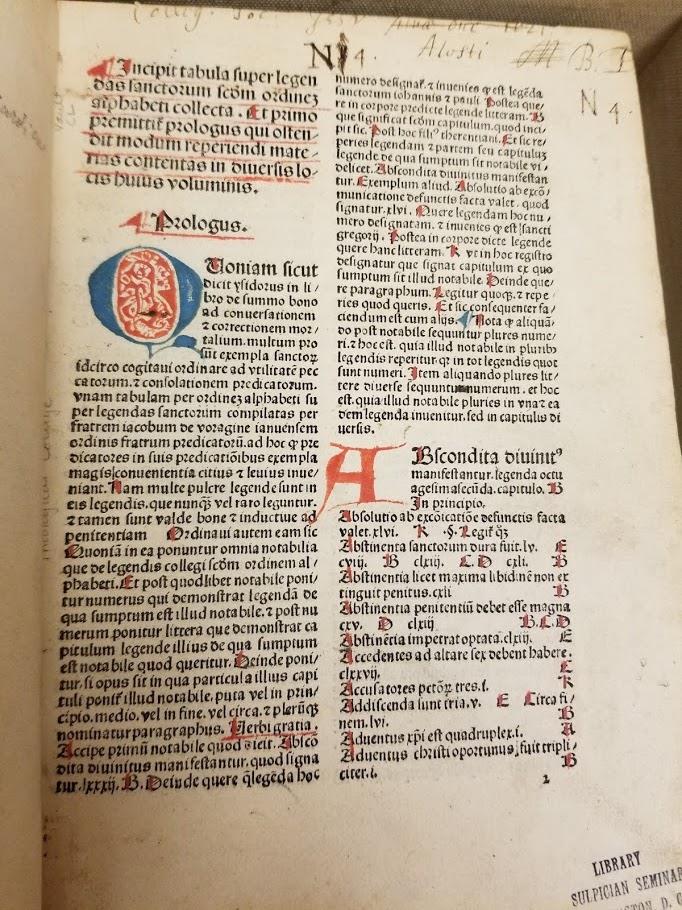
In the image above, we can see an incipit in an incunabula dating from ca. 1490. The incipit, with red highlights and lines accentuated at the top of the first page of text, introduces this printed copy of Jacobus de Voragine’s The Golden Legend.
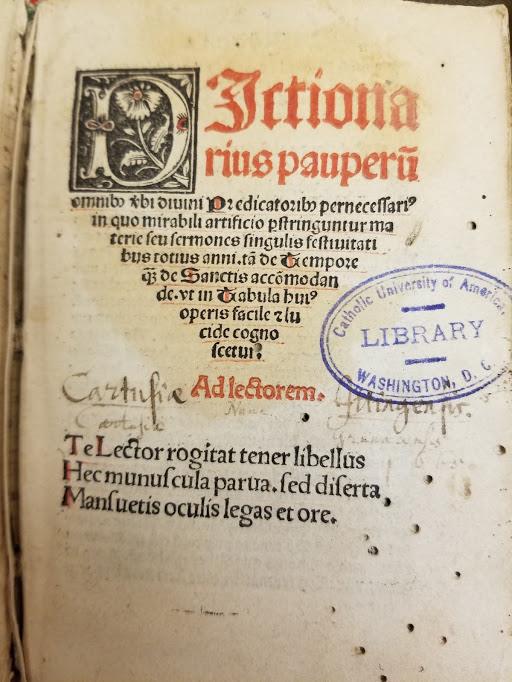
When opening a book, typically the first page one encounters is the title page – a separate page that offers several pieces of information about the work, including the title, author name, and publisher information. The presence of a title page seems rather intuitive, but that assumption underlies how common the title page has become in our expectations on the structure of the book. However, the title page’s story is one of centuries of experimentation, often reflecting the commercial and intellectual trends of the time.

Prior to the era of the printed book, manuscripts did not have title pages. The original rationale behind printing a title on the lead page has often been explained by two key reasons tied to the printing of books. The first is that the printed book was a commercial object, and the presence of a title indicating the book’s contents would help advertise the work to consumers. The second reason has more to do with the economics of early book printing, with the printed work not being bound until much later, usually by a separate binder from the printer. As a result, there was a need to be able to easily identify what the contents of a printed stack were for the bindery and possibly protect the work while in storage and transit prior to binding.

These questions of how best to protect the work, how to identify what one has produced, and how to advertise it to consumers were “new needs brought with the advent of mass production.” Thus, when one compares the printed book to the production of pre-modern books – where binding came about right away and works were transcribed one at a time – it makes practical sense that medieval works would lack a title page.

The first several decades of the printed book – the incunabula period – witnessed much experimentation in how to label printed books. In broad strokes, the early development may be highlighted through the following developments: incipits and colophons, label-titles, and woodcuts and borders.

What came before the printed book? Prior to the late fifteenth century, manuscripts produced in Europe did not have title pages. Many works lacked any title and would usually be identified by one or two features – the incipit and the colophon. The incipit was a common feature of most manuscripts, with it being either the opening line of a text or a distinct line preceding the main text. These lines would be on the first page of the text, sometimes highly ornamented or inked in red. These incipits could be the opening line of the text, a summary of the work contained within the manuscript, or a descriptive title. (The closest modern equivalent to the incipit is the title, with the incipit offering a summary or description of the text’s contents.) During the incunabula period, many early books followed this tradition of manuscript production, using incipits as their “titles”. Publishers would even hire rubricators to add in red ink over the incipit once the text was printed, mimicking medieval manuscript incipits.

The colophon, which was less common than the incipit, was a feature added at the end of a text. While not having its own separate page – usually being included at the bottom of the last page of text – it offered information about the author, context of production, and date. Colophons may describe who transcribed the text, for what purpose or for what audience, and the location and date of production. It may have all or only some of that information. The closest modern equivalent information would be publisher and author details, now located on the title page. In the incunabula era, colophons continued to exist providing the author and production details.

This slideshow requires JavaScript.

Among the first developments of the incunabula period was the label-title. This piece was often a short description on the first page of the printed book. Despite sometimes being marked in red by rubricators after printing, the label-title was distinct from the incipit in that it was separate from the text. The label-title was placed on its own separate page removed from the main textual body, and its content was often abbreviated with a simplistic layout. The short title given to the work would be set in a simple layout, usually a few lines of text or a descending triangular pattern of words. The label-title arguably marks the first appearance of a distinctly recognizable title page.

1492 printing of Gerardus de Zerbolt’s De reformatione, with rubrication, woodcut letter, and a line at the end indicating how a reader may best access the volume.

The next major changes deal with the expansion of intellectual information on the title page. Today when we think of a title page, we often think of it containing the name of the work, the author, and the publisher. Possibly some additional publication information, such as the location of its printing or the date of its publication. In the late fifteenth century, label-titles began to focus more on the printer, publisher, and bookseller. In other words, details related to the commercial side of printing and not the authorial or artistic side. These printer or publisher names and locations could help serve as both publicity and brand markers for a printed work. The publisher may have also added details such as claims about the value of the book or a listing of its textual contents. Meanwhile, dates of publication were a much later addition, as early incunabula continued to often place that information (and the details of the author) at the end of the work on either end-titles or colophons. (End-titles being here label titles that are placed on a separate page at the end of the text.)

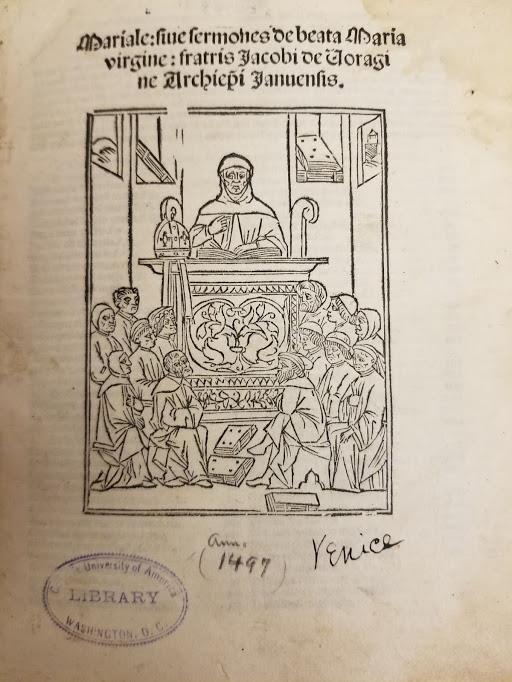
An early sample of a woodcut image added to the text. In this case, the 1497 printing of Jacobus de Voragine’s Mariale et Sermones, is highlighted with a standard woodcut illustrating a sermon or lecture being delivered.

The next developments for title pages comes in the form of imagery, particularly in the forms of wood cuts (and bordered pages by the sixteenth century). Title pages fully designed by woodcut are themselves fairly uncommon, as they were costly to produce and limited the style of lettering in the title or other text on the page. As a result many, many of the early title pages with any woodcut features are products of a mixed method of typeset for the text and a woodcut image.

Many of these early woodcut images were standardized to reflect general themes of the text, the intended usage for the work, or indicate the printer. For example, two typical title page images were one of students reading at a lectern or a pastor delivering a sermon. This was not only an economic way to utilize the same woodcut across multiple works, but it served as a marketing tool for highlighting the intended usage of the work.

This is not to say that there were no later developments nor that other forms of introducing a book’s text did not continue to exist alongside the title page. However, the title page was fairly standardized by the middle of the sixteenth century, with much of the changes in the next few centuries primarily dealing with modifications to the way the text or images on the title page were presented or laid out. By the mid-sixteenth century, the bordered title page was commonplace with an established printing of title, author, publisher, date, etc.

However, to speak briefly on the later developments, we can point to the addition of frontispieces as stylistic drawings that faced the title page. Usually these had no text, but provided a vivid illustration of the text’s contents. Also, beginning in the seventeenth century, the title page began to shift from short titles to long titles with certain words emphasized via distinctive type or ink.

This slideshow requires JavaScript.

By the time the eighteenth-century begins, title pages begin to shorten their titles, with brief text and less ornamentation. However, the nineteenth-century witnessed both trends, with a return of verbose titles and highly ornamented borders and a continuation of less ornate title pages. Finally, when we turn to the past century, title pages seem to have become more subdued in the post-war printing boom. In the digital age, we even continue to place title pages at the start of our ebooks. It is a curious trait to see on a book that does not require physical protection of its text pages, but may perhaps represent a commercial and cultural legacy that has evolved alongside the production needs and choices that ultimately led to the creation of the title page.

For more information:

  • Bartram, Alan. Five Hundred Years of Book Design. New Haven, CT: Yale University Press, 2001.
  • Cole, Garold. “The Historical Development of the Title Page,” The Journal of Library History (1966-1972) 6, no. 4 (Oct. 1971). https://www.jstor.org/stable/25540320
  • Morrison, Stanley. Four Centuries of Fine Printing: Two Hundred and Seventy-two Examples of the Work of Presses established between 1465 and 1924. London: Ernst Benn Limited, 1924.
  • Pollard, Alfred W. Last Words on the History of the Title-Page with Notes on Some Colophons and Twenty-seven Fac-similes of Title-Pages. New York: Burt Franklin, 1891.
  • Smith, Margaret M. The Title-Page: Its Early Development 1460-1510. New Castle, DE: Oak Knoll Press, 2000.
  • Smith, Margaret M. “The End-Title, the Early Title-Page and the Wrapper: Their Inter-Connections,” Transactions of the Cambridge Bibliographical Society 11, no. 2 (1997). http://www.jstor.org/stable/41154861
  • Vlaamse Erfgoed Bibliotheken. “Types of Title Pages.” STCV. Bibliography of the Hand Press Book, Accessed June 16, 2020. https://manual.stcv.be/p/Types_of_Title_Pages.
  • The Archivist’s Nook: Making Memories Through Preservation

    “Preservation is documents and artifacts, recordings, digital media and all the tangible information that requires our professional advocacy and stewardship–the love and sweat of our labor. However, beyond all of that, most importantly, preservation is MEMORY and memory is the people and the communities who make them…”
    – Tamar Evangelestia-Dougherty, Preservation Week Honorary Chair

    Since 2010, the American Library Association has hosted Preservation Week to encourage libraries and archives to consider their preservation practices but also to educate the public about best practices around preserving the documents, artwork, photographs, and digital records that collectively make up our shared cultural heritage. Each year has a theme, with this year’s being: Is This Thing On? Preserving Memory and Building Archives.

    Preservation Week is a time to pause and think about how we are approaching the records under our care, whether you work as a librarian/archivist or are looking after your own or your community’s collection(s).

    In past blog posts, we have discussed persistent issues in preservation, strategies for individuals to preserve their personal records, and the challenges involved in preserving digital records. In light of this year’s theme on memory and building archives, I want to step back and get a little philosophical on the importance of preserving one’s records/stories as an exercise in memory creation and archival building.

    Your Documents Matter

    We can all likely think of personal or familial items that have been preserved through the generations – wedding photographs, family Bibles, love letters, etc. We may even think of records that we keep for legal or financial reasons — tax forms, receipts, deeds, etc. The maintenance of these records — and their passing down — are a form of memory creation. You or your family are preserving the stories that you wish to tell and leaving traces for future generations to reconstruct narratives of the past.

    Archives are built upon the documents and the context that surrounds them. Researchers formulate ideas about the past by utilizing these documents to construct narratives.

    The satchel and a sample of its contents.

    We have many examples in our institutional archives about how personal or familial actions have provided materials for future historians to study the past. For example, we have the correspondence of an Irish-American family during the Civil War. These letters, stored by the family over generations in a chest, have come down to us over 150 years later. We have even received materials saved by families in a small satchel, preserving the story of relief workers during the First World War.

    These personal letters provide insights into immigration history, wartime experiences, and local organizations. But it doesn’t mean that records need to tell grand stories to be valuable and worth preserving. Stories of our ancestors, our lives, our achievements, and our emotional journeys are important. We can value a photograph, a letter, or an email simply because it has emotional value to us, our family, or our community. Do not let the idea of being of “institutional value” dictate what records you value and preserve. Protect and encourage the memories you would want to share with the world.

    It may feel daunting to preserve the documents you wish to add to our shared memory. But there are a few shorthands that can help ease the process. Remember:

    • Items will always deteriorate over time: No matter what the record — analog or digital — it is not immune to time and the elements.
    • Limited resources necessitate planning: We cannot do everything, so prioritize what objects you wish to preserve and actions you wish to take.
    • This selection process will involve value-laden judgments: When deciding what to keep, you may have your own standards to decide what is most important. Institutional archives have collecting policies to keep our decisions focused and well-documented, but for personal collections, you are okay to make decisions based on historical, monetary, or emotional meaning.
    • Doing something is better than doing nothing: You do not need to be a preservation pro to make a difference. The smallest of actions will make a difference in safeguarding your records.

    Preserving Memories

    I grew up in Nebraska and spent a lot of time on my maternal grandparent’s farm. In 2016, my family decided to sell the family farm. At that time, it had been in our family for 99 years with generations raised on the land. Understandably, there were a lot of emotions bound up in this decision and fears of subsequent generations losing the connection to “the Farm”.

    The family farm, tidied up before the auction, 2016.

    During this process, documents were located within the attic that had weathered much over the previous century. These included the original sale note for the land. As this chapter of our family history was ending, the preservation of this document was of great import to us — it would allow us to preserve a small piece of the memory, a memory that we hoped would let future generations know the value of this time in our family’s history.

    Recognizing the need to preserve this document, it was removed from similar items and stored separately to be reviewed for further care in the future.

    Unfortunately, life gets busy and by 2019, the sales note was at risk. Historic floods hit the Midwest and the document suffered water damage. Despite this setback, I did not give up. I continued to do what could be done to preserve the document: Disaster planning, digitization, and rehousing. There is still a lot of work to be done to save this memory, but the steps taken are still steps made in guaranteeing the preservation of this memory. It is never too late to preserve the documents and stories that are important to you or your community.

    We’re all cheering for you!

    When discouraged, remember that doing something is better than doing nothing!

    Plus, there are some great resources out there to help guide you:

    The Archivist’s Nook: 50 Years of Service – Laying the Tracks for DC’s Metro

    Brookland-CUA Metro Station, 2023

    The Metrorail subway system arrived in Washington Saturday and the response was so overwhelming that prospective riders waited in lines for up to four hours to ride in trains that were often so overloaded that they refused to move because of the weight of the overcapacity crowds. – John Koppish, The Tower, Vol 54, Issue 22, (April 1, 1976)

    March 27, 2026 marks the 50th anniversary of the opening of the Washington Metrorail system, with its first trains running between today’s Rhode Island Avenue and Farragut North stations. For half a century, Metro trains have been an integral part of the DC scene and campus experience at Catholic University. This very archivist lives a car-free life thanks to the reliability of the system and the presence of a station right next to campus. But it took a lot of work to get here…

    This slideshow requires JavaScript.

    We may not think about it, but the history of the Brookland neighborhood and CatholicU are intertwined with the history of transportation. After the founding of the University in 1887, the first two new buildings constructed on the campus focused on the educational mission of the school (Caldwell Hall) and the logistical need of getting distant students to the campus (University Station). The Brookland area was largely rural at that time, so transporting folks to the burgeoning campus was a challenge. Baltimore-based architect E. Francis Baldwin was tasked with designing both buildings – an appropriate task, given that Baldwin is known for his work on both train depots and Catholic churches. (Baldwin would also design McMahon Hall in 1895.)

    With Caldwell Hall rising up in 1889, the local train depot opened near campus in 1890. University Station – located where the current Brookland-CUA Metro Station stands today – operated trains from the B&O Railroad between the 1890s and 1950s. The station would be razed to make room for the new Metro station.

    In addition to trains, trolley cars also operated along today’s Michigan Avenue, providing students with access to the downtown core of the District.

    But both the Brookland neighborhood and campus grew in the aftermath of World War II, the increasing need for more transit options emerged. In the postwar period, transportation infrastructure was primarily focused on expanding road access for personal cars. Coupled with the collapse of the DC bus and trolley system in the 1950s, the city seemed prime to invest in personal automotives as the solution to its long-term transportation issues. In that vein, DC was slated to have its own road system vastly expanded, with a large freeway planned through the Brookland neighborhood.

    Emergency Committee on the Transportation Crisis (ECTC) meeting flyer, ca. 1970

    The DC freeway revolts emerged as grassroots opposition to the expansion of the freeway system throughout the District. In particular, organizations emerged such as the Emergency Committee on the Transportation Crisis (ECTC) to fight back against the use of eminent domain to cease individual houses for the road construction, particularly through predominantly Black neighborhoods. Issues around racial justice, environmental sustainability, and home rule were all tied in with the question of the District’s transportation future.

    At the same time, the Johnson administration was forging ahead with plans to develop a subway system for the city. The freeway revolts provided extra fuel to light this cause, with the subsequent Nixon administration continuing in the development of today’s Metro. Catholic University’s leadership was thrilled by the prospect of having a future Metro station near campus, with plans to use the former University Station site as the location for a stop. With that said, however, the University faced the challenge of the proposed freeway system through its neighborhood.

    With students and faculty in protest, the University came out against the freeway expansion in 1971. It helped that one of the proposed routes of the road would’ve taken the freeway along today’s Metro red line path, meaning cars would be speeding along constantly next to the then-new science buildings on campus.

    If you walk out to John McCormack Drive today, you obviously do not see a freeway but a Metro line instead. So, after years of activism, the community efforts to stop the road plans were successful and Metro was built. With its grand brutalist architecture and expansion of the past several decades, Metro’s development and history is too rich to summarize in this simple blog post, so I’ll skip ahead. (Check out the sources below to learn more!)

    This slideshow requires JavaScript.

    This gets us back to that busy, busy opening day in 1976. While the Brookland Metro Station would not open until 1978, the campus was thrilled about the first trains to run in the system with bated breath for the eventual opening on our own local stop.

    After years of construction – and debate over the name of the station – Brookland’s station would open on Feb. 6, 1978 – with the local student newspaper dedicating an entire special issue to the grand opening.

    Still celebrating the Brookland Metro station in the stacks, 2026.

    Today, the Metro remains an essential part of life in the broader DC area. Whether you love the system or sometimes get frustrated with delays – I’m guilty of both – CatholicU would not be the same without its train operators announcing the arrival at the Brookland-Catholic University station. So a happy golden anniversary to our beloved local system!

    Learn more:

    Schrag, Zachary. The Great Society Subway: A History of the Washington Metro. Baltimore, Maryland: The Johns Hopkins University Press, 2006.

    “50 Years of DC’s Iconic Metro.” Washingtonian, March 11, 2026. https://washingtonian.com/2026/03/11/dc-metro-rail-wmata-history/

    “Milestones & History.” WMATA, 2026. https://www.wmata.com/about/history/

    The Archivist’s Nook: The Mystery of Mullen’s Washington Portrait

    Dear readers, do you ever look up in Mullen Library and notice a blank spot on the wall? Was anything displayed there, if ever? And if there was once something there, what happened to it? Well…

    Washington in Mullen, ca. 2010

    The portrait of George Washington by Gilbert Stuart, which His Eminence Cardinal Spellman presented to the Catholic University in memory of Patrick Cardinal Hayes has arrived at the University.

    So begins a letter dated July 17, 1947 sent from the office of Catholic University Procurator, Rev. James Magner, to St. Patrick’s Cathedral Rector in New York. In the same letter, Magner notes that the University had not yet removed the portrait from its shipping crate nor selected the optimal site for its installation.

    Within months of this letter, the painting would be firmly placed in the John K. Mullen of Denver Library, affixed to the north wall of the main reading room. The portrait was joined with a similar life-size portrait of James Cardinal Gibbons, which hung on the opposite (south) side of the reading room. From these vantage points, Washington and Gibbons could watch over generations of Cardinals as they represented the dual nature of the University – Catholic and American.

    Gibbons in Mullen, 2022

    While Gibbons continues to watch over the reading room, Washington is noticeably absent. Where is George today?!

    From 1947-2015, Washington hovered over the north face of the reading room, until conservation issues necessitated the painting’s removal to storage. So mystery solved, right? Alas, that is not the true mystery of Washington. The true mystery was reignited when University staff began to explore conservation efforts into the piece – who truly painted the portrait?

    I wonder whether you have any information that you could let me have relative to the history and authenticity of the portrait of George Washington by Gilbert Stuart, which His Eminent Cardinal Spellman was so generous as to present to the Catholic University. –
    Rev. Magner to New York, Sept. 24, 1947

    When originally donated, the painting was thought to be the famous 1796 Lansdowne Portrait by Gilbert Stuart or a Stuart sanctioned copyist. But by the late 1960s, doubt began to creep into the picture. The museum inventories from 1951 and 1981 illustrate this shift, with the former directly stating it was a Stuart and the latter indicating that it is “after Stuart (attributed by some to Stuart)”.

    This information, however, slipped away from the popular consciousness of the campus. The Gilbert Stuart original entered campus lore like the Exorcism Room or Dorothy Dress, with tours and literature often making this claim. However, as 2015 dawned and new research began into the painting for its conservation, it was soon realized that it may be one of possibly four or five rogue copies by artist William Winstanley. A fascinating character in his own right, Winstanley is infamous for boldly creating unauthorized duplicates of Stuart’s works. These works have often been difficult to differentiate from the authentic pieces, partly as a result of lost provenance and a desire for institutions to claim a Stuart original. Even the authorship of the copy held in the White House has been the subject of debate for over 200 years!

    What we do know about the copy held on campus is that it belonged to The Catholic Club of New York, before being donated to Catholic University by Francis Cardinal Spellman. It hang for nearly 70 years, with a variety of attributions over the decades. It is now safely in storage, awaiting conservation and future exhibits. And perhaps the mystery of its authorship is solved! Evidence strongly suggests Winstanley, but we await a day where we can display it once again for audiences to weigh the evidence themselves.

    Learn more about the other Washington items held in Special Collections here.

    You may also learn more about the ongoing debates about the White House Washington portrait (and how CatholicU’s copy may be used in solving the question) by reading:

    Evans, Dorinda. “William Winstanley (fl1791–1808) Gilbert Stuart’s Shadow and a Swindling Genius.” The British Arts Journal 20, no. 3 (Winter 2019/2020): 98-110.

    The Archivist’s Nook: America at 250 – Reflections from Special Collections

    Exhibit Poster

    As the United States approaches the 250th anniversary of the Declaration of Independence, the nation is looking back on its history, institutions, and peoples. During the spring semester 2026, Special Collections will showcase highlights from the University’s collections, reflecting on the founding and ensuing generations of Americans. Beyond giving examples of our national history, the exhibit invites you to consider how the past 250 years are remembered and what they mean to you.

    This exhibit will be on display in the Mullen Library Main Reading Room in Spring 2026, with an online exhibit available here: America at 250 – Reflection from Special Collections

    The Archivist’s Nook: From Wool Mills to West Point – The Story of One Irish-American Family in the Nineteenth Century

    George Ryan to his parents, May 30, 1858.

    >Ft. Leavenworth K.T. [Kansas Territory]
    May 30th 1858

    My Dear Parents

    Tomorrow we will take up our line of march and although I have a great deal to do I take the advantage of a few moments leisure to write you a few lines…

    So begins a letter from George Ryan (signed Your aff son) to his parents, John and Johanna Ryan. This letter represents one of over 1200 individual pieces of correspondence contained in the Ryan Family papers at CatholicU.

    This is a collection of an Irish American family’s correspondence, primarily spanning two generations from the 1820s through the American Civil War. Starting with their arrival in Massachusetts, going into business and raising families in Connecticut, later moving on to Illinois and Missouri, the Ryans were involved in business, politics, immigration, the Catholic Church, and the military.

    The first generation – John, Mathew, Charles, and Kyran Ryan – was born in Ireland and arrived in New York City on July 10, 1827. The brothers started their lives in the United States, working in the textile mills of Massachusetts. In 1835, John Ryan married Johanna Boomer Reed and their first son, George, was born one year later. Also in 1836, the Ryans purchased a woolen mill of their own in Norfolk, Connecticut. (They would operate this mill for the next 20 years.) John and Johanna’s family would grow to include 12 further children in addition to George.

    John Ryan’s appointment to Decatur, Illinois postmaster, signed by President Andrew Johnson, 1865.

    John, who is the focus of the collection in this generation, became deeply involved in local Democratic politics and the temperance movement. He was heavily involved in helping Irish Potato Famine refugees in the 1840s. In 1858, following the dissolution of the family mill, John took his family to Decatur, Illinois, where he worked as a lawyer and the local postmaster.

    George Ryan, ca. 1860

    In the 1850s, the focus of the collection shifts to the next generation, with correspondence primarily from John and Johanna’s first two children, sons George and Mat. George graduated from West Point in 1857 as a commissioned officer in the 7th Infantry. This position took him to Utah in 1858 as part of the Utah War and to New Mexico in 1860 as part of the Navajo Wars. Upon the outbreak of the Civil War, George spent time as a prisoner of war, only to be paroled in 1862. From 1863-1864, he served as the commander of the 140th New York Volunteer Infantry Regiment. In May 1864, George was killed leading a charge the next day at Laurel Hill, beginning the Battle of Spotsylvania Court House.

    Upon George’s death, his personal effects were sent to his surviving family in a footlocker inscribed with a comrade’s last name, “Crilly”. This footlocker would serve as the Ryan Family paper’s home until its donation to CatholicU in 2002, passed down from descendants of his brother Mat.

    Mathew Ryan, ca. 1860

    While George pursued a military career, Mat focused on business and obtained an appointment as a wartime sutler for a hometown volunteer regiment, the 35th Illinois. Mat followed this regiment through Missouri and into the Tennessee theater of war. Mat, marrying Nancy Lawrence, settled in St. Louis and became a successful businessman and local politician, serving in the Missouri legislature.

    The many stories contained within the thousands of letters of the Ryan Family papers are difficult to summarize, but detail the story of an Irish-American family navigating the challenges of nineteenth-century America. The collection is transcribed and available digitally online here: Ryan Family Papers

    The Archivist’s Nook: New Exhibit – The Light They Carried – Celebrating Luminaries of Catholic University History

    LSC843 and Special Collections staff, celebrating the installation of the exhibit, November 17, 2025.
    For more than a century, Catholic University has drawn remarkable individuals who have shaped its culture, inspired its students, and enriched its archives. The latest exhibit in the John K. Mullen of Denver Library’s May Gallery celebrates a sample of the luminaries who have led with light in their fields and in their lives.

    This exhibit was curated by Dr. Maria Mazzenga’s Public Programming class (LSC 843) during Fall 2025. Materials come from Special Collections, which includes Rare Books, Archives, and the Museum Collections as well as the Semitics/Institute of Christian Oriental Research (ICOR) Library.

    Below are brief biographies on the profiled luminaries, as written by Dr. Mazzenga and her graduate students:

    Cardinal James Gibbons (1834-1921) – The First Chancellor
    by Dr. Maria Mazzenga

    Cardinal Gibbons and ex-President Theodore Roosevelt with warm greetings for each other in 1918. (CatholicU Special Collections)
    Cardinal Gibbons and ex-President Theodore Roosevelt with warm greetings for each other in 1918. (CUA Archives)

    Cardinal James Gibbons played a central role in the founding of CatholicU and served as its first Chancellor. One of the most influential voices in American Catholicism, Gibbons dedicated his life to showing that Catholic faith and democratic principles could coexist in harmony.

    His leadership helped shape a confident, intellectually engaged Catholic presence in a nation often suspicious of the Church. When Gibbons advocated for the University’s establishment in 1887, he envisioned a national institution that would unite faith and reason, nurturing Catholic scholarship at the highest level.

    Gibbons’ and the U.S. Bishops’ decision to base the University in Washington, D.C., symbolized a new era of Catholic intellectual life in the United States, one that continues to influence the University’s mission and identity today.

    Henri Hyvernat (1858–1941) – Catholic University’s First Professor
    by Dylan Orshefsky

    Rev. H. Hyvernat.

    Professor Hyvernat was one of CatholicU’s first professors, and one of its longest serving. From a young age, he showed great proficiency with language, and as part of his education through seminary, he became fluent in many Middle Eastern languages, including Coptic, Syriac, and Arabic.

    In 1887, he was asked by Bishop John Keane, CatholicU’s first Rector, if he would be interested in joining the nascent university. Henri agreed to do so, and since there would be some time left before the university fully opened in 1888, Henri and his fellow seminarian alumni Paul Müller-Simonis secured a grant from the French government to perform an epigraphic expedition through parts of Georgia, Armenia, Kurdistan, and Mesopotamia.

    Along the way, Henri acquired many manuscripts and materials that would be usable as part of his research and instruction at the university. Upon finishing his tour and starting at Catholic, Hyvernat was soon made head of the Department of Semitic and Egyptian Languages, a position he held until his passing.

    Monsignor Arthur T. Connolly (1853–1933) – Patron of Learning and Art
    by Daniel Buck

    Msgr. Arthur Connolly portrait, donated on his birthday (December 2) in 1930. The plaque reads, “Rt. Rev. Msgr. Arthur Theodore Connolly 1853-1933 Library Patron”

    Arthur T. Connolly was born to Irish Immigrants in Boston. He dedicated his life to the Church as a priest, spending most of his life as a parish priest in the Archdiocese of Boston. Most of the people would have known him as a dedicated pastor, however he is a CatholicU luminary in his role as a collector and donor.

    Msgr. Connolly was an avid traveler and collector of art and rare books. While he collected for himself, he also collected for the public. He was a trustee of the Boston Public Library, and he donated books to universities, including Catholic.

    His initial donations, which came in the 1910s, were in the form of academic texts meant to fill out the university library. He donated rare books and art, including a Nuremberg Chronicle and a collection of ivories. These donations form the core of the modern rare book collection of the University sought out by historical researchers.

    Edward John Pryzbyla (1904-2000)
    by Amy Glen

    Edward J. Pryzbyla, far right, at one of his many tree-plantings on the CUA campus, 1990.

    Edward John Pryzbyla (“Eddie” or “Pryz”) was a beloved CatholicU alumnus and philanthropist. Born to Polish Catholic parents in Chicopee, Massachusetts in 1904, he grew up loving his community. Arriving at CatholicU at sixteen, he quickly became known for his energy, kindness, and involvement in student life. He graduated in 1925 with a BA in Philosophy. After graduating, he returned to Chicopee, where he built a successful career in insurance, real estate, and finance.

    A devoted alumnus, he rarely missed meetings of the Alumni Association or Board of Governors, and his generosity transformed the campus through scholarships, landscaping, and ultimately, the Edward Pryzbyla Center – “The Pryz.” His many honors, including the Cardinal Gibbons Medal and an honorary doctorate, reflected his selfless spirit.

    Regina Flannery Herzfeld (1904–2004) – Trailblazer in Anthropology
    by Sadie Colebank

    Image of Regina Flannery Herzfeld
    Regina Flannery, 1938.

    Regina Flannery Herzfeld was a trailblazer both at CatholicU and in the field of Anthropology. After getting her master’s and doctorate degrees in Anthropology at CatholicU in the 1930s, Dr. Herzfeld joined Father John Montgomery Cooper, founding Chair of Catholic University’s Department of Anthropology.

    At a time where there were few women in Anthropology, Dr. Herzfeld faced discrimination because of her gender. Dr. Herzfeld defied expectations and went on to become the University’s first full-time female professor. However, Dr. Herzfeld’s time at the University was also marked with misogyny. For eight years, from 1938-1944, women were not allowed to teach classes in their own right. Despite this she persevered in her work and later became the first female department chair at the University.

    Dr. Herzfeld focused her research on the roles of women and children in Indigenous North American life. Most of Dr. Herzfeld’s work was with the Cree and Inuit peoples in northeastern Canada and the Gros Ventre people in Montana. Arguably her best known work was with her Cree collaborator, Ellen Smallboy, who provided great insight into Cree life in James Bay, Canada.

    Euphemia Lofton Haynes (1890–1980) – Mathematician and Educational Reformer
    by Jiton Davidson

    Euphemia Haynes Lofton, Educational Superstar of the District of Columbia. Here, she is pictured with her Ph.D. in Mathematics from CUA. Haynes Lofton was the first African American woman to graduate with a doctoral degree in math in the U.S.

    Dr. Euphemia Lofton Haynes was born in an affluent black neighborhood in Washington, D.C., just twenty-five years after the ending of chattel slavery. Her free-born parents, teacher mother and dentist father, encouraged her love of learning. With a profound sense of service to those less fortunate, young Euphemia used her talents as a teacher, orator, department head, D.C. Public School Board president, and education advocate to help to secure a more equitable school system for black children after segregation, when racial oppression took on subtler forms.

    Dr. Haynes was the first African American woman in the country to earn a doctorate in math, which she received from Catholic University of America in 1943. Using her knowledge and experience, she helped to shift the trajectory of the education system in the Nation’s Capital from standardized IQ and aptitude tests as determining factors in the type of education a student was to receive.

    Dr. Euphemia Lofton Haynes was a fierce advocate following her Catholic faith, and she was rewarded with the Papal Medal Pro Ecclesia et Pontifice in 1959.

    Right Reverend Monsignor James A. Magner (1901-1994) : Administrator/World Traveler
    by Abigail Hibbs

    Riding an elephant in India, 1978.

    Joining Catholic University in 1940, Monsignor Magner served for nearly three decades in multiple leadership roles, including Assistant Secretary Treasurer, Director of the University Press, and Vice Rector for Business and Finance. Magner earned doctorates in Sacred Theology and Philosophy in Rome. His administrative stewardship during years of institutional growth ensured the University’s financial stability and academic expansion.

    Throughout his life, Monsignor Magner led various trips around the world. Traveling had always been a passion of his and as he loved learning about different cultures. After his retirement in 1968, Monsignor Magner moved to Palm Beach, FL but continued to lead his annual group trips in addition to his personal travel. He captured his travels through photographs and video film and he brought back hundreds of objects which now are in the museum collection here at CatholicU.

    Sister Thea Bowman, F.S.P.A. (1937–1990) – Voice of Faith and Culture
    by Philip Reynolds

    Photo courtesy of: Sister Thea Bowman Cause for Canonization

    Sister Thea Bowman was a pioneer of black education at Catholic University, where she not only attended (earning both a MA and PhD in English), but created the University’s first course on black literature.

    Nationally recognized, she worked around the nation, advocating for awareness bridging cultural gaps with music, teaching. She tirelessly shared the joy of a faith of which she carried an enriched expression, evident in her colorful native African garb and the soulful melodies of her voice.

    “I bring myself; my black self, all that I am, all that I have, all that I hope to become,” she once told the U.S. Conference of Catholic Bishops. “I bring my whole history, my traditions, my experience, my culture, my African-American song and dance and gesture and movement and teaching and preaching and healing and responsibility – as gifts to the Church.”

    Following her time at Catholic, as an alumna, she pulled the black experience of Catholicism away from the margins and into a position of greater awareness and visibility. After teaching at the university level for two decades, she moved to Jackson, Mississippi to work as an intercultural consultant for the diocese there. She would play a key role in publishing the first work of its kind tailored for the black community: “Lead Me, Guide Me: The African American Catholic Hymnal”. To this day, she is remembered as one of the most notable and influential members of the Catholic University alumni family, with an open cause for canonization.

    Gerald Weiner (1941–2025) and Barbara Weiner– Collectors, Philanthropists, and Cultural Bridge-Builders
    by Sebastian Vinueza

    Gerald Weiner

    Born into a Jewish family in Chicago, Gerald Weiner, a financial executive and philanthropist, grew up with a deep awareness of faith, loss, and cultural preservation. His early encounter with the Holocaust inspired an interest in preserving Jewish traditions and led him to the plight of Ethiopian Jewish immigrants. What began as a search for Ethiopian Jewish manuscripts evolved into a mission to safeguard Ethiopia’s Christian and Islamic manuscripts.

    Gerald and Barbara Weiner understood that these manuscripts were important heritage to the Ethiopian diaspora communities in the United States, particularly the Washington D.C. metropolitan region. They worked to keep them preserved, accessible, and meaningful for scholars and communities which they belong to.

    Over a decade, with a final and posthumous gift in 2025/2026, Gerald and Barbara Weiner donated a total 953 Ethiopian manuscripts and scrolls (Ge’ez, Amharic, Arabic) to The Catholic University of America. Their generosity has made the Semitics/ICOR Library a space for intercultural study and dialogue, strengthening the University’s role as a steward of cultural heritage.

    To learn more, visit the exhibit on campus through spring 2026 or contact us at: lib-archives@cua.edu
    The Archivist’s Nook: Voices from the Stacks…or A Tale of Sea Witches, Skeletons, and (Pocket) Monsters

    A Mercedes McCambridge publicity photo from the 1949 film All the King’s Men. (Photo: AP Wirephoto.)

    “The wonder of sound! I believe the most distinctive, the most telling facet of any actor’s ability is the way he sounds. What sound is there in him that strikes the fire in us?…[sound] paints the picture, tells us the whole story of the person who is making the sound.”

    -Mercedes McCambridge, The Quality of Mercy (New York: Times Books, 1981), page 72.

    During her time as an artist-in-residence, Academy Award winning actress Mercedes McCambridge acted alongside and taught CatholicU students. Known for her decades of radio and voice work, McCambridge made sure to imprint on her students the import of voice work and its distinction from stage acting.

    Among the storied history of CatholicU’s Drama program, there have been numerous stage, screen, and (much to McCambridge’s delight) voice actors. Today, I would like to highlight a few of the most vocal of our alumni. This is not an extensive list, but one that many current students and alumni may recognize, if not for their faces than for their voices…

    Pat Carroll

    Pat Carroll (l) and Ursual (r). (Courtesy: Wikimedia Foundation)

    Born in 1927 in Shreveport, Louisiana, Carroll’s family moved to Los Angeles when she was young. She began acting early in life, and enrolled at CatholicU while enlisted in the U.S. military. While a student, she began acting professionally in 1947. In the ensuing decades, she starred in numerous roles across stage, screen, and television including in comedic programs beloved by this archivist such as The Carol Burnett Show, The Red Skeleton Show, and Laverne & Shirley. In the late 1980s, Carroll began to accept voice acting roles that lasted until her passing in 2022. Among the productions in which she provided her voice talents are: A Pup Named Scooby Doo, The Goofy Movie (1995), My Neighbor Totoro (1988), and several animated Garfield features. But she is most well-known for being both the spoken and singing voice of Ursula in Disney’s The Little Mermaid (1989). This is a role she would continuously voice throughout later animated and video game adaptations of the character.

    Check out a sample of Carrol’s voice work here: Ursula, The Little Mermaid (1989)

    Chris Sarandon

    Chris Sarandon (l) and Jack Skellington (r). (Courtesy: Wikimedia Foundation)

    Born in 1962 in West Virginia, Chris Sarandon attended West Virginia University for his undergraduate studies before enrolling at CatholicU for a master’s degree in theater. He graduated with his MFA in 1967.

    Sarandon has had a prolific career since his graduation, with accolades for stage performances to Academy Award nominations. Given the Halloween season, it may be appropriate to mention his roles in the horror film Child’s Play (1988) and his role as the villainous Prince Humperdinck in the cult classic The Princess Bride (1987). But as we are speaking of voice roles, many of our readers may recognize him from his speaking role as Jack Skellington in The Nightmare Before Christmas (1993), a role that he has reprised in other productions including the Kingdom Hearts video game franchise. (Danny Elfman provided the singing voice for Jack.)

    Check out a sample of Sarandon’s voice work here: Jack Skellington, The Nightmare Before Christmas (1993)

    Kathleen Charlotte McInerney (Veronica Taylor)

    Kathleen Charlotte McInerney (Veronica Taylor) (l) and Ash Ketchum (r). (Courtesy: Wikimedia Foundation)

    Kathleen Charlotte McInerney, professionally known as Veronica Taylor, has deep roots on the CatholicU campus. Her parents attended the University and toured with Fr. Gilbert Hartke’s National Players. With these theater roots, she knew from an early age that she wanted to be an actor. Earning a Bachelor’s degree in Drama at CatholicU, Taylor was involved in the National Players and a co-founder of the women’s soccer team. She credits the Drama faculty, saying, “Everything I do is a result of something I learned from them, be it technique, discipline, or just love of the craft and its history.” Following graduation from CatholicU in 1987, she earned a Master’s degree from Brandeis University in 1993.

    Her work has included audiobook narrations, ad reads, voice-overs, and voice work for animation. Her work has included starring roles in Teenage Mutant Ninja Turtles and the English dubs of Japanese anime, including such shows as Sailor Moon, One Piece, and Pokémon. Among the many roles she has provided in Pokémon, she is best recognized for voicing the main character, Ash Ketchum.

    Kathleen McInernery (Courtesy: Catholic University)

    Echoing McCambridge, McInerney reflected on her career in 2015, stating: “It has been incredibly fulfilling to play so many characters who are so different from myself. ‘Voice acting’ requires a full body commitment, and the engagement of all of your technique and training to come together and funnel out through your mouth. You don’t have the luxury of gesture, a look, or movement, you just have sound. It’s quite a fun challenge.”

    Check out a sample of McInerney’s voice work here: Ash Ketchum, Pokémon (1997)

    Any favorite roles among the listed voice actors or any notable alumni voices that we missed? Let us know by contacting us: lib-archives@cua.edu

    The Archivist’s Nook: Allison Hayes – A Giant on the Screen and in Advocacy

    Hayes, Catholic University Alumnus, 1955

    “My CU experience helped me the most…They taught me how to work together with a team for success. I found that, in doing this, you don’t think of yourself and feel that people are just watching you.”

    Catholic University Alumnus, Volume 18, no. 2 (Winter 1955)

    Born on March 6, 1930 as Mary Jane Hayes, future Hollywood actress Allison Hayes started her life from humble beginnings in West Virginia. As a young child, her family relocated to Washington, D.C., where she graduated from Calvin Coolidge High School in 1948. The young Hayes was a musical savant, performing at the piano from the age of 5 and winning performance tournaments and even touring as a teenager. Her ambition was to become a concert pianist, and to help secure this dream, she won the title of Miss District of Columbia in 1949 to secure a scholarship. This decision led to her competing for several years in beauty pageants and working as a model. [Source]

    After several years along this career tangent, Hayes enrolled in the CatholicU Speech and Drama program in 1952, majoring in music. While on campus, she sought theater courses to build up her confidence. As she stated in a 1976 interview, “I had always been quite shy and introverted. I thought if I could learn to get up on a stage and learn to project myself in another character, another role, that might help my self-confidence. Some of the things I did [at CatholicU] were the best things I ever did.” [Source]

    Tower article, October 28, 1955

    Juggling her acting, modeling, and teaching piano lessons while studying full-time proved a challenge Thus after studying on campus for three semesters, Hayes soon departed for Hollywood in 1953. She first signed on with Universal Studios before transitioning to Columbia Pictures. During her early acting career, Hayes was prolific in Western and comedies, but suffered from onset injuries that held back her rising star.

    By the mid-1950s, Hayes became a frequent television actor, appearing on shows as varied as Bat Masterson, Rawhide, Perry Mason, and more. But it is in the late 1950s that she landed the roles that she most often remembered for today – cult horror and sci-fi films. Between 1957-1960, Hayes co-starred in 6 Roger Corman B-movies focused on zombies and supernatural spectres. But it was the 1958 Attack of the 50 Foot Woman that placed her within the ranks of cult film royalty. The poster alone for the film has been parodied and referenced countless times in popular culture.

    Movie poster for Attack of the 50 Foot Woman, 1958

    These successes were unfortunately marred by a mysterious health crisis that began to emerge in the 1960s. Beginning in 1962, Hayes began to take a calcium supplement at the advice of a physician and was soon experiencing a host of negative symptoms including fatigue, hair loss, and partial paralysis. After years of uncertainty, Hayes came across a description of lead poisoning among factory workers, and the symptoms fit her illness perfectly. By 1970, toxicology tests concluded that she had metal poisoning from six years of taking the calcium supplement. It contained 190 parts of lead per million and was an unregulated medication from England.

    Promotional still from “Count Three and Pray”, 1955

    After years of being doubted by her doctors and having no one idea what ailed her, Hayes recalled her initial reaction upon learning of this diagnosis, “My first reaction was one of relief. I hadn’t been losing my mind…then the anger set in. I’d spent thousands of dollars being bandied about from one specialist to the other with not a few of them baldly implying that my problem was primarily psycho-neurotic…in the end I had to depend on myself to educate the experts.” [Source]

    From here, she launched a campaign to get the Food and Drug Administration (FDA) to regulate imported supplements. She wanted to use her ordeal to strengthen oversight in the industry and prevent others from suffering as she had. For the remainder of her life, she lobbied the FDA for these changes. In a bittersweet moment, the FDA finally accepted more heavy-metal testing standards for supplements in 1977, just weeks after Hayes passed away from leukemia.

    Before she passed away, Hayes penned a final poem:

    When the time comes
    For the final line to be
    Drawn through my name
    In those personal address books,
    Will it be done slowly
    Or rapidly?
    I should like to leave
    More than one less “H”
    So please hear me
    I have been poisoned

    Credit: Art Hondros

    With this poem, Hayes calls out for the world to remember her voice and make sure none will suffer the same fate. From humble roots and piano performances to the heights of B-movie fame and medical activism, Hayes leaves behind a legacy of film and health advocacy that touches many lives to this day. [Source]