
Like many cultural heritage institutions across the United States, we have been eagerly anticipating this year’s 250th anniversary of American independence. We have prepared articles, exhibits, and planned our personal holiday celebrations. But before we part ways for the long holiday weekend and head to our various parades or barbecues, we wish to give a brief reflection on American history as told through six objects from our collections. Each member of the Special Collections selected one item from the collections to highlight an aspect of American history.
Romantic Portrayals of the American Landscape
selected by Shane MacDonald, Curator of Digital & Museum Collections

Heinrich Vianden (1814-1899), a German-born American artist who settled in Wisconsin in 1849, one year after the state entered the union. Influenced by the Romantic movement of the age, his paintings reflected the landscape of his new country. He trained generations of American artists from his school near Milwaukee. Among his interests was painting the Wisconsin Dells, a natural site in the state that was becoming a destination in the latter half of the nineteenth century.
This style of painting may invoke the Hudson River School, a Romantic movement primarily focused on landscape painting in the nineteenth century, capturing the scenic beauty of the American continent. While Vianden is not a direct member of this group, he nevertheless demonstrates the richness of the art movement in the first American century and its shaping of subsequent art. An immigrant to the United States and an artist, Vianden’s painting invokes a love for the natural beauty of his adopted land.
The Fourth of July Fondly Recalled
selected by Alexis Howlett, Special Collections Technician

W. J. Howlett (1847-1936), an Irish immigrant priest and author. Traveling across the Western United States before settling in Kentucky, he composed an autobiographical manuscript in his eighty-seventh year of life. Throughout the work, he “necessarily looks backward in his spare moments” (Howlett Memoirs, 7). This distance, Howlett says, may heighten the enchantment or exaggerate the view of little nothings; but, he takes pleasure and finds amusement in looking back over the disappearing vista of his life. Recounting the flurry of memories from his childhood into his older age, he recalls a timeless experience of the Fourth of July as he experienced it as a young boy growing up in Kentucky ca. 1860.
We were patriots also. The Fourth of July always found us ready with flags, firecrackers, toy cannons to show our American spirit, but I guess it was rather to have a good time at some of the lakes fishing and swimming and making up some picnic party. The more serious part of the program was left to older heads, and there was no lack of zeal among them in making the whole affair a success as planned. (Howlett Memoirs, 26)
He concludes the passage recognizing that, as a young man, he found the fun of the day more interesting than its history.
Volunteerism in Times of War and National Crisis

W. J. Shepherd, University Archivist and Head of Special Collections, has worked with hundreds of archival collections and thousands of documents, books, photographs, and other material items for more than three decades in CatholicU’s Special Collections. Selecting a favorite to honor the nation’s 250th anniversary is no easy task. However, he chose a colorful World War I poster titled ‘See Him Through -Help Us To Help The Boys,’ created jointly in late 1918 by the Knights of Columbus and the National Catholic War’s Council (NCWC), known in the twenty-first century as the United States Conference of Catholic Bishops (USCCB).
The poster was one of many as part of a one-week fundraising effort, the United War Work Campaign of November 11-18, requested by President Woodrow Wilson to seven voluntary American religious organizations, including the Knights, NCWC Salvation Army, Jewish Welfare Board, YMCA, YWCA, and the American Library Association (ALA) to boost the morale of soldiers and war workers via recreational activities. It successfully raised over $200 million, the 2026 equivalent of over $4 billion! The NCWC records, held by Special Collections, are among its most significant and highly used holdings and a particular focus of Mr. Shepherd’s work throughout his career.
Service in War and Peace
selected by Abigiail Hibbs, Graduate Library Pre-professional
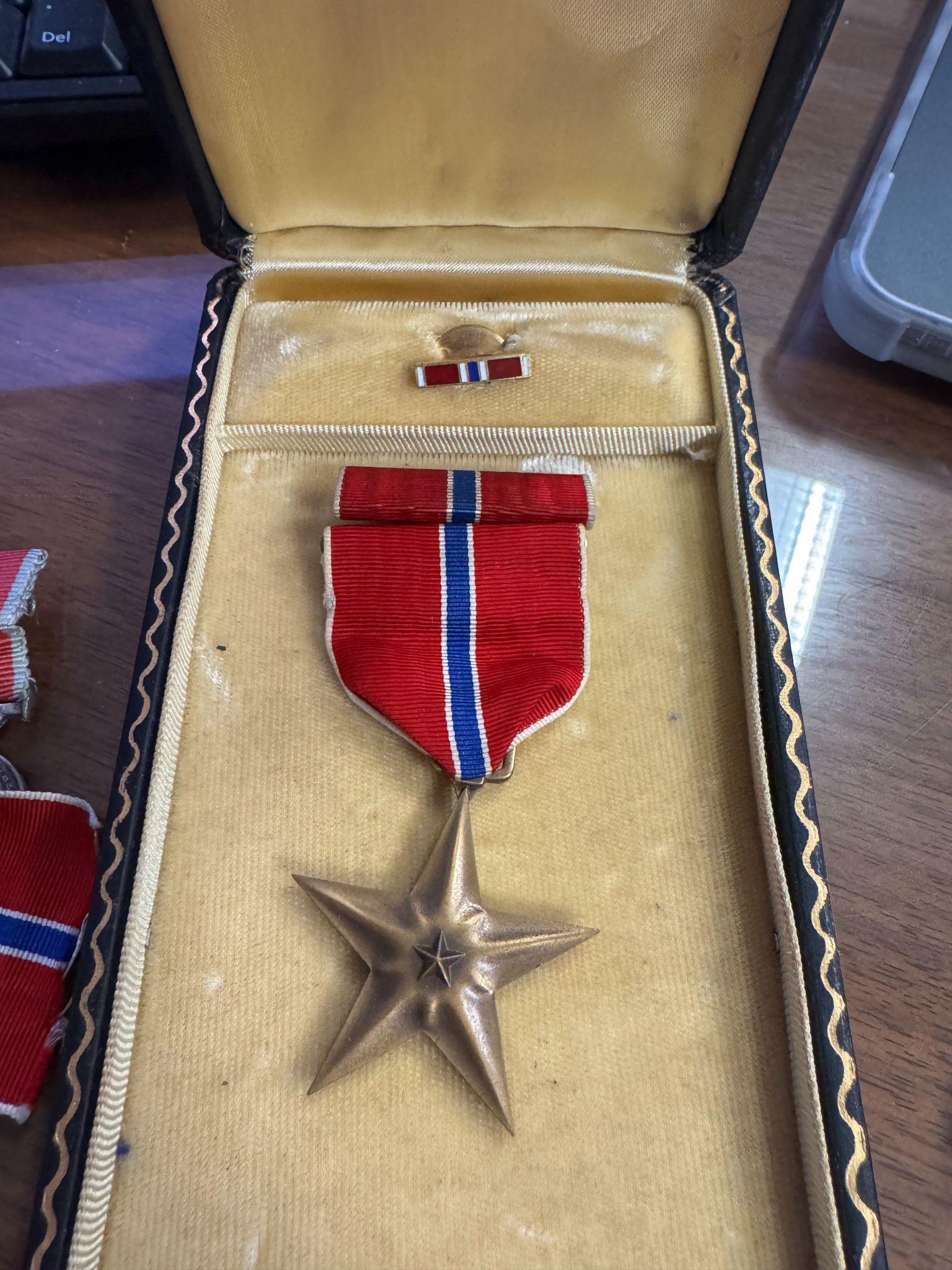
The Bronze Star is awarded for heroic or meritorious achievement or service in the armed forces. It was first awarded during World War II and is one of the highest military honors. This Bronze Star was awarded to Bernard Mann Peebles who served in the U.S. Army during WWII. This subcommittee also known as the Monuments Men, were tasked with recovering, inventorying and investigating cultural artifacts damaged or stolen from Italy during the war.
Later Peebles was a professor of Greek and Latin at Catholic University where his personal papers are now held. He used his expertise to develop much to the University’s Rare Books library over his tenure.
Forming a Catholic American Identity
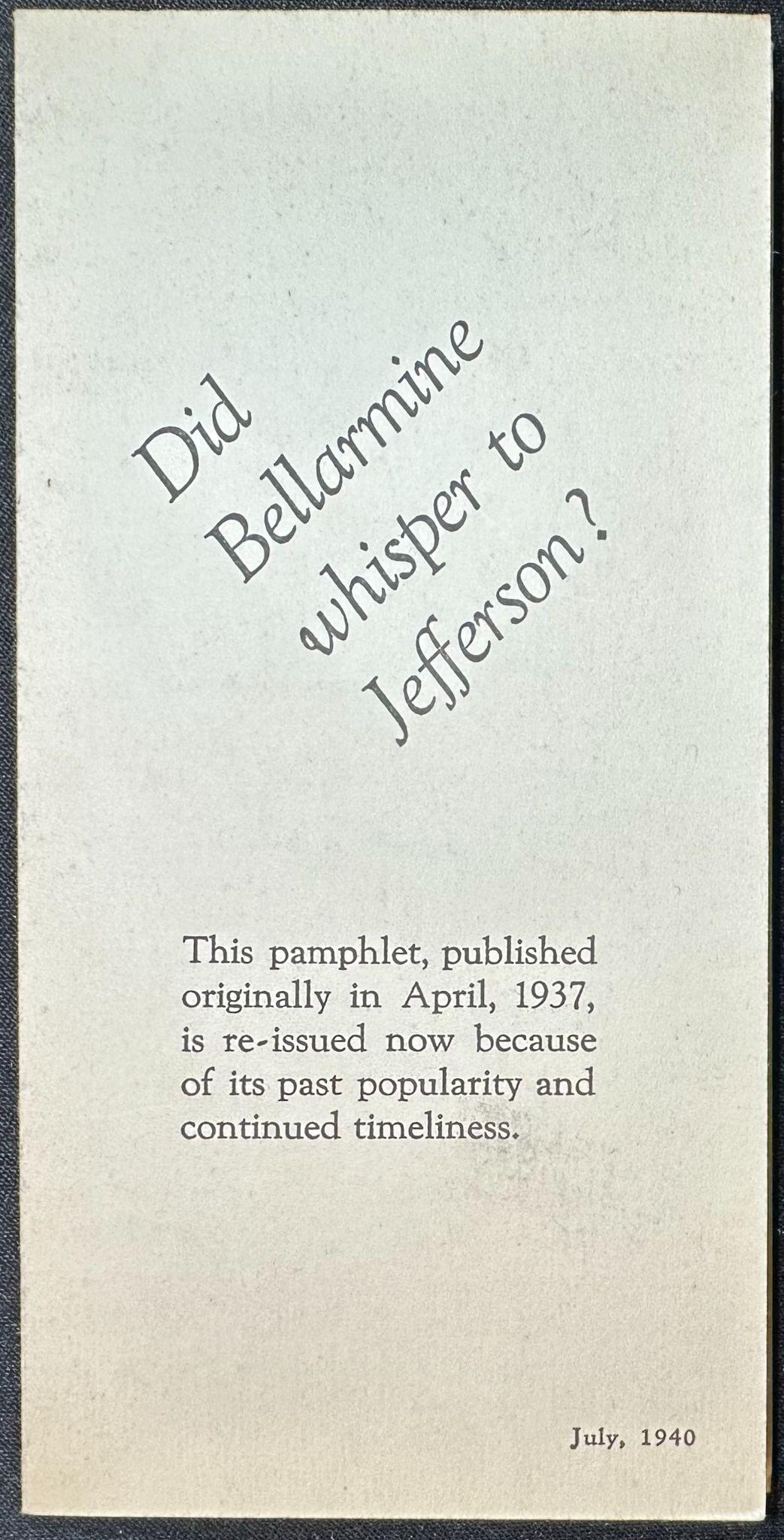
Sally Kendrick, Rare Books Librarian, highlights a pamphlet entitled “Did Bellarmine Whisper to Jefferson?”, published in 1940 by the Catholic Information Society. The author points to similarities between the writings of St. Robert Bellarmine (1542-1621) and the text of the Declaration of Independence, commenting, “we wonder, we Catholics, whether at least a whisper from the great theologian did not reach the ear of the great statesman.” This is not the first suggestion of such a connection. Historian Gaillard Hunt published on the topic in the Catholic Historical Review in 1917, but the theory of a clear line of transmission connecting Jefferson to Bellarmine did not meet with widespread scholarly acceptance.
Ultimately, this pamphlet says more about 1940 than it does about 1776. By the early 20th century, American Catholics had experienced generations of widespread anti-Catholic sentiment. The Bellarmine-Jefferson connection thus gained popularity among them as an indication that their identities as Catholics and as Americans were not in competition and that the highest American ideals were, in fact, Catholic in origin. Although the specific historical argument it makes regarding Bellarmine is not now commonly believed, this pamphlet represents a step along the path of Catholic identity-making in America.
Finding Common Ground in a Democracy
selected by Darren Stephens, Special Collections Assistant
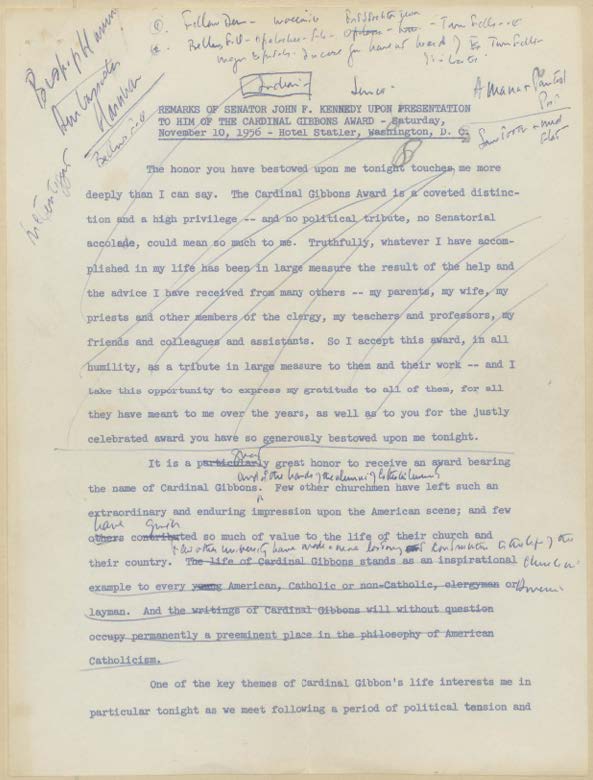
On November 10, 1956, 39-year-old Massachusetts Senator John F. Kennedy stood at the Statler Hotel in Washington, D.C., to receive the Catholic University of America’s James Cardinal Gibbons Medal, the highest honor conferred by the university. While this was a night of personal recognition for the man who had narrowly lost the vice-presidential nomination at the Democratic National Convention in August, it served as a powerful platform to articulate his vision for American politics. Having already built a resume that included naval heroism and a successful congressional career, Kennedy used his acceptance speech to invoke the legacy of Cardinal Gibbons, a figure whom in many ways Kennedy emulated, praising the late Cardinal as a “mediator and conciliator” who worked to integrate Catholics into American life, opposed the idea of a hyphenated American, and thrust himself into the contentious issues of his time in search of solutions, all the while never compromising his or the Church’s principles or wavering in his affability. (“Remarks of Senator John F. Kennedy upon presentation to him of the Cardinal Gibbons Award,” November 10, 1956, Kennedy Folder, Small Collections, Catholic University of America Archives.)
Speaking just days after the 1956 election, Kennedy also delivered a prescient message about the dangers of political polarization, advocating for “a spirit of dissent and constructive criticism that is consistent with a spirit of national unity…and political partisanship that is consistent with the national good.” He warned against the “amateur political scientists” who sought to divide the nation into rigid liberal and conservative camps, fearing it would create a dangerous religious fervor in politics. Decades before the current era of intense partisanship, Kennedy argued that bipartisan cooperation was essential for the national interest, particularly with regard to foreign policy amidst the Cold War and the escalating Vietnam War, and that the two-party system at the time, with its “mixed views,” served as a vital check on extremism. This address was a formative moment, where he publicly honed the themes of national unity over narrow interests that would come to define his iconic presidency, the first of a Roman Catholic, four years later. (“Remarks of Senator John F. Kennedy at the Cardinal Gibbons Award Dinner,” November 10, 1956, Speech Files, 1953-1960, Speeches and the Press, Senate Files, Pre-Presidential Papers, Papers of John F. Kennedy, John F. Kennedy Presidential Library and Museum, JFKSEN-0896-009.)