Streaming Media: Challenges and Opportunities

Every two years, the ACRL Research Planning and Review Committee publishes in College & Research Libraries News an article on the top trends and issues affecting academic libraries and the change our institutions are experiencing. We will be highlighting some of these trends through a number of blog posts over the next few weeks.


In a world in which technology is advancing more rapidly than ever before, streaming media – media that is presented to users in real time as they need or desire to use it – has become especially pervasive. Streaming services are one of the key ways in which we watch television; listen to music; and access lectures, live theater performances and other internet resources for research and entertainment purposes. From Netflix to Hulu, subscription numbers continue to rise. This was the case even before the COVID-19 pandemic kept many people at home.

Remote students appreciate streaming services (American Libraries Magazine, 2016).

Educators have long known that images and audio provide information that is not always apparent through the written word and that students have different learning styles. For example, some are visual learners and are best able to process and retain information that is conveyed in images. For that reason, we have seen teachers at all levels incorporating visual content into the curriculum to complement assigned texts.

As librarians and information professionals, it is our responsibility to note these changes and see how we can apply them to best serve our patrons. So it should come as little surprise that libraries too have started subscribing to streaming services.

Just as individuals weigh factors in deciding which and how many of the ever growing and competitive offerings they will select – Disney+, Sling, Amazon Prime, Curiosity Stream, Peacock, Criterion Channel, Apple – librarians take several factors into consideration when choosing the streaming services available to libraries. These factors include: content, ease of use and accessibility, and budgeting terms and costs.

Common educational materials available through streaming services.

Content

For librarians, the process of selecting streaming services is not as simple as subscribing to a favorite platform with your favorite sitcoms. There are other factors to consider. Are there streaming services that cater to an especially large group of students on campus engaged in similar kinds of research? Will the instructors be showing these films in the classroom? Does the streaming service limit its offerings to education films? Is there also demand for popular films, film classics, television programs, recent mainstream movies, documentaries, animated films, concerts, and/or foreign-language films? If so, which service has the content most requested by the university community? Does the service include features such as captions and the ability to select and save a film clip?

Ease of Use and Accessibility 

Librarians have also seen the usefulness of subscribing to streaming media services because it allows them to meet students wherever they are, whether or not those students are coming onto campus to take classes. Many students had taken advantage of options for online education before the beginning of the COVID-19 pandemic. Classes offered for students enrolled in online (and in-person) programs might require accessing films for reading or research purposes. Academic librarians must pay careful attention to what kinds of classes are being offered, just as they do when choosing print materials commonly used in courses offered at their university.

During the recent pandemic, faculty in particular have faced significant challenges in providing resources for their students while teaching them virtually. One benefit of streaming services is that even if library staff are unable to work onsite and provide access to scans of library print materials for classroom use, reference librarians can point professors to streaming services accessible through library databases. Given this increased need to consider the preferences of faculty and other users while library service remains limited, patron input will continue to be invaluable for librarians even after they can once again access physical library materials.

These charts show selection methods commonly used by librarians.

One final trend to note is the recent need for librarians to consider access by the entire college or university community when choosing streaming media. The goal is to find resources that allow students with disabilities equal access. When it comes time for librarians to consider which subscriptions to renew, they will increasingly consider how resources measure up to the accessibility standards put in place by the library and the university (Schroeder 2018, 401). Issues related to accessibility include small print; limited voice output or recognition; and PDF documents that are not formatted to be compliant with updated standards (Schroeder 2018, 405, 409). As is made clear from this case study, it is now required that many librarians will be familiar with issues of accessibility and able to offer support to students needing accessible resources.

Budgeting Terms and Costs 

Budgetary constraints also restrict the kinds of streaming services that academic libraries can provide. When libraries provide students and faculty with access to streaming services, it is generally because they have worked with vendors to obtain a license for particular groups of films, documentaries, recordings, etc. These licenses guarantee a price for only a certain amount of time, and changes in price and content require acquisitions librarians to revisit existing subscriptions frequently. They must remain aware of copyright agreements and competing interests among streaming service providers in order to ensure that those services continue to provide access to a specific set of resources. In some instances, patron-driven models – which require payment based upon students’ use of electronic materials – become too expensive for libraries. Because of these considerations, streaming services must be evaluated in light of the library’s collection development policies: the policies libraries use to guide their decision-making when acquiring new materials (Wahl, 2017). Ensuring that license agreements comply with copyright regulations can also occupy librarians’ time.

Another way to highlight the unique challenges libraries face in deciding between streaming media services is to differentiate between institutional and individual subscriptions. Students and faculty are aware of the monthly standardized fees that they pay for their own personal subscriptions. However, they are unlikely to be aware of the financial strain that subscriptions at the institutional level can cause: the streaming services simply become another “free” service provided by the library. Chris Cagle acknowledges this in his article published in Film Quarterly. He explains that students probably have little idea that their use of streaming materials can have this kind of impact on a library’s budget. While librarians choose streaming services that provide access to a wide range of resources, these streaming services can become out of reach if they require that libraries pay according to frequency of patron use. Recognizing that no service can provide access to everything, librarians might begin choosing less expensive subscriptions to services that have comparatively limited access rather than services such as Kanopy that offer extensive access at a potentially crippling cost.

Services at Catholic University Libraries 

The Catholic University Libraries subscribe to a variety of streaming services, including audio and video (for a complete list, click here). Two of our latest additions are Quest TV, a service offering access to concerts and documentaries, through September 30th of next year, and On the Boards TV, a portal for viewing performance films of ground-breaking artistic projects in dance, theater, music, and experimental forms. Look beyond HBO Max…you might be surprised what you find!

Additional Reading

Dunn, Cathy. 2020. “Streaming Video Acquisitions: Factors to Consider.” Journal of Electronic Resources Librarianship 32, no. 2: 133-135.

Lowe, Randall A., et. al. 2020. “Managing Streaming Video: The Experiences of Six Academic Libraries.” Journal of Electronic Services Librarianship 32, no. 2: 119-126.

Rodgers, Andrea. 2019. “Once upon a Time in Streaming Video: A Community College’s Adventure with Kanopy’s PDA Model,” College & Research Libraries News 80, no. 9. https://crln.acrl.org/index.php/crlnews/article/view/23578/30892

Schroeder, Heidi M. 2018. “Implementing Accessibility Initiatives at the Michigan State University Archives.” Reference Services Review 46, no. 3: 399-413.

Wahl, Mary. 2017. “Full Steam Ahead: Designing a Collection Development Workflow for Streaming Video Content.” Library Resources and Technical Services 61, no. 4. https://journals.ala.org/index.php/lrts/article/view/6471/8573

Wang, Jian, and Elsa Loftis. 2020. “The Library Has Infinite Streaming Content, But Are Users Infinitely Content? The Library Catalog vs. Vendor Platform Discovery.” Journal of Electronic Resources Librarianship 32, no. 2: 71-86.

The Archivist’s Nook: The Small World of E. Francis Baldwin


The 1883 Sykesville B&O Station on the bank of the Patapsco River was, until recently, Baldwin’s Station & Pub. The building has been celebrated for its “lively Queen Anne jumble of gables” (Lewis xvi). Drawing by Wiley Purkey from the author’s personal collection.

Because I commute all the way from Sykesville, Maryland down to the Catholic University campus, it took me a while to realize that the “E. F. Baldwin” responsible for the University’s first new construction was in fact the same E. F. Baldwin after whom my favorite local restaurant was named. Small world! Sadly for me, Baldwin’s Station & Pub was sold to new owners this past summer, but they’re still running a restaurant out of the historic train station.

It turns out E. Francis Baldwin (1837–1916)—as his name often appears; the E. stood for Ephraim—was a prolific architect.

Among Baldwin’s most iconic extant works are the “four-block-long” B&O Camden Station Warehouse, which baseball fans might recognize as the backdrop to the Baltimore Orioles’ ballpark at Camden Yards; the Point of Rocks B&O Station (“to many, the quintessential Victorian railroad station”); and the 22-sided B&O Passenger Car Shop in Baltimore—“oftentimes erroneously referred to as a ‘roundhouse’”—which the B&O Railroad Museum now calls home (Avery 60; Harwood xiv; Avery 54).

Clockwise from upper left: the B&O Camden Station Warehouse (1898), the Point of Rocks B&O Station (1875), and the 22-sided B&O Passenger Car Shop (1884)—home of the B&O Railroad Museum. All photographs courtesy of the B&O Railroad Museum.

Meanwhile, in the CatholicU universe, Baldwin is remembered as the architect of Caldwell Hall and McMahon Hall—the first two buildings constructed after the University was established in 1887. Today, Caldwell and McMahon are the two oldest extant buildings on campus. Baldwin attended the cornerstone laying ceremony for Caldwell on May 24, 1888 and saw it through to completion in 1889. A year later he was asked to oversee the construction of McMahon, which was completed in 1895.

Long story short, Baltimore was the common factor in Baldwin’s career with both the Baltimore & Ohio Railroad and the Catholic Church. During Baldwin’s lifetime, Baltimore was the “mother of American railroading,” but before and since that time the city has been recognized as “the locus of the first Catholic diocese in America” (Harwood xi; Lewis xv). Baldwin’s decision to base his architectural firm in Baltimore had important repercussions; on the one hand he “became the principal architect for the Catholic Church in Maryland,” but on the other hand he found that “his radius of action” was largely restricted to “the reach of the Baltimore & Ohio Railroad”—sealing his fate as “a parochial rather than a national figure” (Lewis xv).

An important “bread-and-butter account” in his early architectural career, the B&O remained Baldwin’s biggest client from the early 1870s through the late 1890s; he became for all intents and purposes its “house architect,” much like his mentor John Rudolph Niernsee (1814–1885) before him (Avery viii; Lewis xvi). Diagnosing Baldwin as a “chronic Baltimorean,” Michael J. Lewis explains Baldwin’s relative obscurity compared to his first partner, Bruce Price, who left the firm in 1873, enjoyed a distinguished career as a domestic architect, and is supposed to have influenced the far-more-famous Frank Lloyd Wright: “But for this [Price] had to move to New York—a choice that Baldwin, constrained by the bonds of patronage and clientele, could not make” (Lewis xvii).

The 1890 University Station at Catholic University in Washington, D.C. The station was demolished sometime in the 1970s to make way for the Metro. Upper photograph from the University Photograph Collection, Box 41, Folder 1. Lower photograph courtesy of the B&O Railroad Museum.

Unfortunately, the building that best represents the marriage of Baldwin’s work for the B&O and the Catholic Church is no longer with us. Built in 1890, University Station at CatholicU was razed and replaced by the Brookland–CUA Metro Station sometime in the 1970s. University Station was one of only a handful of B&O stations executed in the Richardsonian style—named after Baldwin’s contemporary Henry Hobson Richardson (1838–1886). In November 1889—the same month that Caldwell Hall was dedicated—the B&O offered to build the young University a “neat and convenient” station out “of blue Georgetown stone so as to harmonize with the handsome university building.” As Carlos P. Avery points out in his definitive history of Baldwin, “That harmony was ensured, of course, because E. Francis Baldwin was the architect for both buildings” (Avery 41).

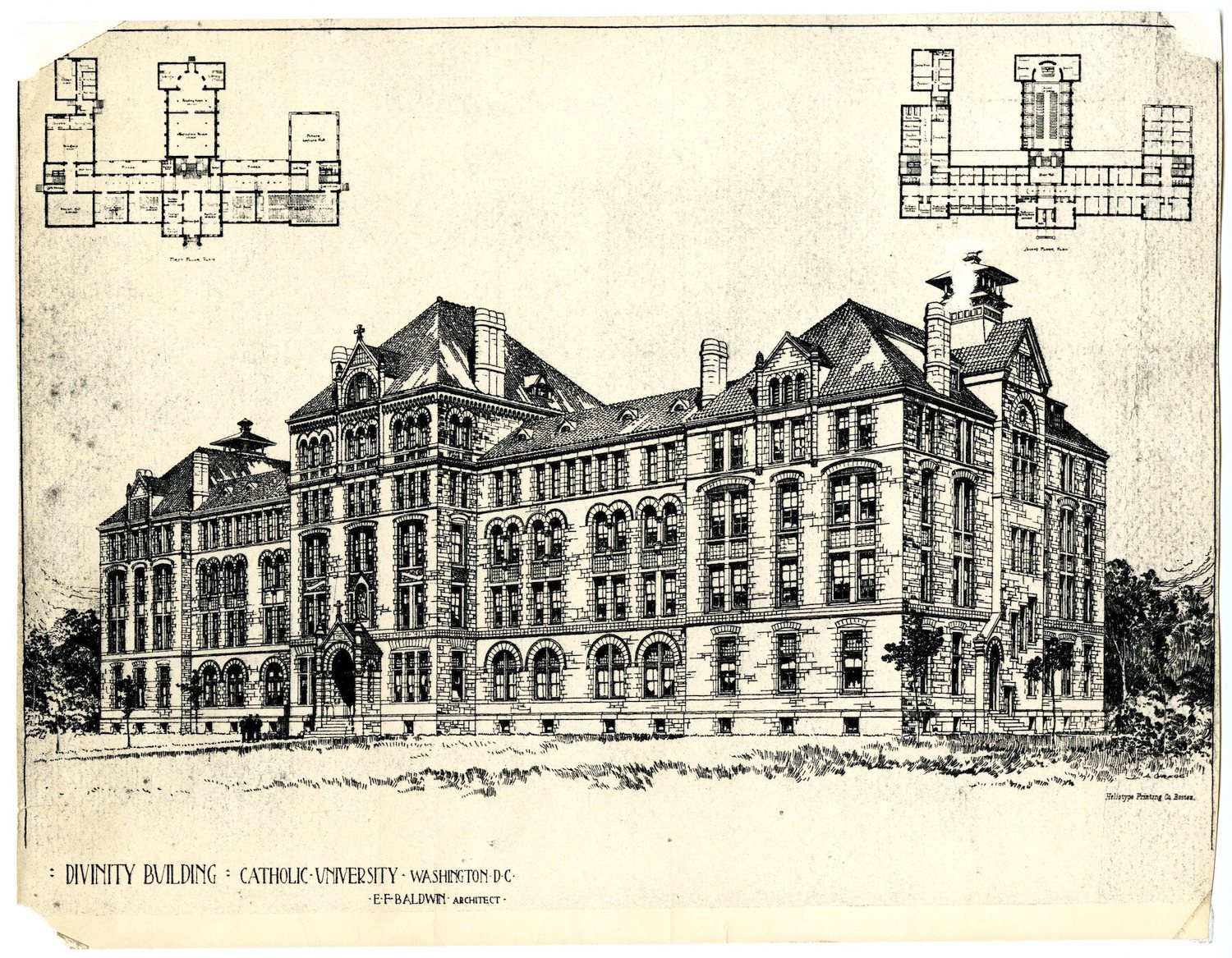
According to Avery—who spent about as many years researching Baldwin as Baldwin spent working on B&O projects—the University’s first rector, John J. Keane, personally prepared the plans for Caldwell Hall (then-known as the Divinity Building) after rejecting all of the proposals that had previously been submitted as part of a design competition (Avery 81). As an aside, one of the competitors was fellow Baltimore architect George A. Frederick (1842–1924), who Avery variously describes as Baldwin’s “arch-rival” and “nemesis” (Avery vii).

In his history of Keane’s rectorship (1887–1896), Patrick H. Ahern credits Baldwin with putting Keane’s plans in “working shape” (Ahern 34). Letters from Baldwin to Keane reveal Baldwin’s role in introducing a number of pragmatic measures—perhaps the most notable of which was the decision to use “Georgetown gneiss rock, with Ohio sandstone trimmings” instead of brick (Ahern 34). In a letter dated September 5, 1887, Baldwin at first politely acquiesces to Keane’s request to execute the building in brick but then goes on to

“strongly recommend the substitution of stone in place of brick, for the reason that brick, in a few years, will become rusty and shabby, rendering painting almost a necessity which then becomes a mortgage in the shape of renewal every 5 to 10 years—whilst stone is rather improved by age, as time and weather combine to add color and picturesqueness to its already most substantial and enduring character. The extra cost of stone would be about 3% on the cost of the building, amounting to not much more than one painting of the brick walls” (Baldwin 5–6).

In short, Facilities can thank Baldwin for sparing them the trouble of having to paint the exterior of Caldwell for the last 130 years!

Architectural drawing of the Divinity Building (a/k/a Caldwell Hall) by Baldwin. Not everyone was a fan of the design; an early resident once denigrated it as “an asylum with a brewery attachment” (Nuesse 165). From the University Photograph Collection, Box 33, Folder 2.

This brings me to one of Baldwin’s greatest strengths as an architect, which unfortunately also seems to be the other main reason for his relative obscurity today. Although I’ve focused on his work for the B&O and CatholicU, the truth is that “he worked on a large number of projects for a wide-ranging clientele—secular and ecclesiastical, public and private, commercial and social” (Avery vii). In other words, Baldwin was extremely versatile—even chameleon-like. No doubt, his versatility came at the expense of developing a signature style; it’s not really feasible to point to a Baldwin the way you could a Van Gogh; but does that constitute an artistic failure on Baldwin’s part? As I’ve learned more about Baldwin in the last few weeks, I’ve been impressed by the way he somehow shaped the regional landscape without leaving his fingerprints all over it. He seems to be everywhere and nowhere. In Lewis’s estimation, Baldwin belonged to the class of humble Victorian architects who simply “felt their task was to serve their clients ably and responsibly, to translate their programmatic requirements into durable, efficient, and fashionable designs, and to guard their clients’ money zealously” (Lewis xv). Perhaps nothing better supports this characterization than the aforementioned September 5, 1887 letter to Keane, which Baldwin signed “Your Obedient Servant.”

Acknowledgements

Special thanks to Anna Kresmer, MSLIS—Archivist at the Hays T. Watkins Research Library of the B&O Railroad Museum—for helping me obtain many of the photographs included in this piece.

References and Further Reading

Ahern, Patrick H. The Catholic University of America — 1887–1896 (The Rectorship of John J. Keane). Washington, D.C.: The Catholic University of America Press, 1949.

Avery, Carlos P. E. Francis Baldwin, Architect: The B&O, Baltimore, and Beyond. Baltimore Architecture Foundation, 2003.

Baldwin, E. Francis. Letter to Catholic University Rector John J. Keane. 5 September 1887. Box 1, Folder 7. Office of the President/Rector. The American Catholic History Research Center and University Archives, Washington D.C.

Harwood, Herbert H., Jr. Foreword. E. Francis Baldwin, Architect: The B&O, Baltimore, and Beyond, by Carlos P. Avery, Baltimore Architecture Foundation, 2003, pp. xi–xiv.

Lewis, Michael J. Introduction. E. Francis Baldwin, Architect: The B&O, Baltimore, and Beyond, by Carlos P. Avery, Baltimore Architecture Foundation, 2003, pp. xv–xvii.

Lord, Charles K. Letters to Catholic University Rector John J. Keane. 29 November 1889 and 13 January 1890. Box 1, Folder 2. Office of the President/Rector. The American Catholic History Research Center and University Archives, Washington D.C.

Malesky, Robert P. The Catholic University of America. Arcadia, 2010.

Nuesse, C. Joseph. The Catholic University of America: A Centennial History. CUA Press, 1990.

Changes to Curbside Pick-up

Beginning Monday, November 30, curbside pick-up becomes book pick-up and moves from the back of Mullen Library to inside its front doors.  Library borrowers will still need to follow the instructions in the Libraries COVID-19 Information Guide to request a specific book(s) and schedule a pick-up time, but we anticipate that this change will save staff time and enable us to fill more requests.

Book pick-up hours from November 30 through the end of the semester will be M-F, 11 AM – 1 PM and M, W, F, 3 – 4 PM.

Library borrowers will enter the library wearing a face mask.  They will show their CU ID to the guard at the Welcome Desk and be directed to the opposite side of the Welcome Desk where they will pick-up their bagged item(s) and exit the library.

Catholicism and the U.S. Presidency: Context and Resources

While Catholics have been an integral part of American history for hundreds of years, President-elect Joseph R. Biden will be only the second U.S. President who is Catholic. At University Libraries, you can find a wealth of research and records on the intersection of Catholicism and the United States Presidency.

Anti-Catholic Pamphlet from 1928
Anti-Catholic literature attacked Democratic candidate Al Smith in 1928.

The first major presidential candidate of Catholic faith was Al Smith. Smith was a New York City politician of working-class origin. After working to enact social reforms into law, he served four terms as Governor. In 1928, he earned the nomination of the Democratic Party for candidate for president. Anti-Catholic sentiment was pervasive at the time, however, and this prejudice greatly affected Smith’s fortunes. The Ku Klux Klan, newly resurgent in the 1920s in part because of anti-Catholic and anti-immigrant sentiment, burned crosses to protest the Democrat’s election campaign. Smith lost to Herbert Hoover, who was inaugurated in 1929.

For more information on Al Smith and anti-Catholicism, visit the American Catholic History Research Center and University Archives, which preserves and maintains original records relating to these events. Their Anti-Catholic Literature Collection features anti-Catholic pamphlets circulated at the time of the 1928 U.S. presidential campaign. Blog posts in our Archivist’s Nook series, including one on the eve of Pope Francis’ campus visit, include digitized versions of these pamphlets. In addition, the department maintains other collections of anti-Catholic literature.

Picture of JFK
The Alumni Association presents then-Senator John F. Kennedy with the Cardinal Gibbons Award in 1956.

The first American Catholic to be elected U.S. President was John F. Kennedy. Kennedy was the son of a businessman (who served as first SEC chair and Ambassador to Great Britain), a hero of World War II, and a U.S. Representative, then Senator, from Massachusetts. In 1956, the University’s Alumni Association awarded Kennedy the Cardinal Gibbons Medal at November’s homecoming dance. The Alumni Association had given the award annually to a person who “rendered distinguished service to country, Church, or the Catholic University.” Digitized copies of student newspaper The Tower, maintained by University Libraries, detail Kennedy’s acceptance speech.

Like Smith, Kennedy faced anti-Catholic prejudice in his 1960 run for the presidency. For example, a Protestant organization led by Norman Vincent Peale, the “National Conference of Citizens for Religious Freedom,” politicized Kennedy’s religious faith by accusing him of being captive to the Roman Catholic Church’s views. The young senator dedicated an entire election speech to his political independence and swore that if “[the] office [of the presidency] would require me to either violate my conscience, or violate the national interest, then I would resign.” While Kennedy achieved a narrow win against Richard M. Nixon (who was raised as a Quaker), he faced a double-standard: the win required him, and not his rival, to frequently address his religious faith.

Since Kennedy’s untimely death in 1963, only two Catholics have been nominated by a major political party for the U.S. Presidency: Senator John Kerry of Massachusetts, and President-elect Biden. (Pat Buchanan ran under the obscure Reform Party ticket in 2000.) Kerry lost to George W. Bush in 2004, and later served as U.S. Secretary of State under President Barack Obama.

Joe Biden Official Portrait
Official portrait of Vice President Joe Biden in his West Wing office at the White House, 2013

Kennedy’s visit in 1956 is one chapter in a series of presidential visits to Brookland. President-elect Biden visited campus at least three times in the 1970s, usually as a guest of student government to speak on the topic of being a Catholic in politics. Keep reading our What’s Up blog for future blog posts on Biden’s connections to The Catholic University of America.

In addition to the archival collections, blog posts, and online documents linked above, check out the online resources linked below to learn more about JFK and religion in U.S. politics.

The author would like to thank Special Collections Archivist Shane MacDonald for assistance in research for this blog post.

References

Dallek, Robert. An Unfinished Life : John F. Kennedy, 1917-1963 . 1st ed., Little, Brown, and Co., 2003.

Schlesinger, Arthur M. The Crisis of the Old Order, 1919-1933 . Houghton Mifflin, 1957.

Related Online Resources

Burns, James MacGregor. John Kennedy : a Political Profile . Open Road Integrated Media, 2017.

Casey, Shaun. The Making of a Catholic President Kennedy Vs. Nixon 1960 . Oxford University Press, 2009.

Dallek, Robert., and Robert. Dallek. John F. Kennedy. Oxford University Press, 2010.

Kennedy, John. “John F. Kennedy’s Inaugural Address.” John F. Kennedy’s Inaugural Address, Project Gutenberg.

Smith, Robert Charles. John F. Kennedy, Barack Obama, and the Politics of Ethnic Incorporation and Avoidance. SUNY Press, 2013.

The Archivist’s Nook: African American History-Related Collections

In his landmark 1990 scholarly work, The History of Black Catholics in the United States, Cyprian Davis presents a deeply researched history of African American Catholics in the United States. He proved that, while Black Catholics seemed invisible across U.S. Catholic history, in fact, the American Church has never been exclusively a white and European one. In fact, as he writes, “the African presence has influenced the Catholic church in every period of its history.” He concludes that for “[t]oo long have black Catholics been anonymous. It is clear they can be identified, that their presence has made an impact, and that their contributions have made Catholicism a unique and stronger body.”[1] In that spirit, we offer an overview of some of our richest materials related to the Black Catholic experience in the United States, including the papers of Father Cyprian Davis himself.

From left: Rothell Price; Bishop James Lyke, O.F.M, Auxiliary Bishop of Cleveland; Father Cyprian Davis, O.S.B., and Leo Hodges, at a talk given by Bishop Lyke on the implementation of the Bishops’ Pastoral on racism, February, 1984. From the Davis Papers.

In 2015, Special Collections acquired the papers of Father Cyprian Davis. Davis, born Clarence John Davis (1930-2015) in Washington, D.C., was a historian and archivist. A convert to Catholicism in his teenage years, Davis expressed an early interest in the priesthood. He joined the seminary of St. Meinrad Archabbey in Indiana, where he became a novice in 1950, and took the monastic name Cyprian in 1951. Ordained a priest on May 3, 1956, Davis became the first African American to join the monastic community of St. Meinrad.

He began his academic career in 1948, studying at The Catholic University of America in Washington, D.C. where he received a Licentiate of Sacred Theology in 1957. Davis then studied church history abroad at The Catholic University of Louvain, Belgium, where he obtained a licentiate in 1963. He taught church history at St. Meinrad before returning to Louvain for his doctorate degree in 1977. Father Davis authored and co-authored several pioneering monographs, including Christ’s image in Black: The Black Catholic community before the Civil War and The History of Black Catholics in the United States. Davis’s papers include many unpublished manuscripts on Black history and Black Catholic history, as well as correspondence, academic papers, printed material, audiovisual records, ephemera, and a range of awards and honors. A finding aid for the Cyprian Davis papers can be found here.

For insights into how white Catholics sought to promote interracial activities within the Catholic Church in the first half of the twentieth century, researchers can consult the records of the Catholic Interracial Council of New York (CICNY). Father John LaFarge, S.J., founded the CICNY in 1934 to promote mutual understanding and social justice among Blacks and whites. The CICNY disseminated information and held meetings and conferences on Catholic teaching and race. Through the 1940s, the CICNY addressed issues such as the Scottsboro Boys’ case, lynching, communism, and efforts to open the defense industry to Black workers. They also regularly honored Catholic civil rights activists with a number of annual awards and celebrations, including the annual John A. Hoey Interracial Justice Award. The idea of interracial councils led to their formation in Chicago, Detroit, St. Louis, and Washington, D.C. By 1954, 24 Catholic Interracial Councils had been created.

An undated photo of a gathering of members of the CICNY from the CICNY Records.

The CICNY continued well into the 1990s, but had declined markedly in activity and importance by the late 1970s. The Interracial Review, of full set of which can be found in the voluminous CICNY Records, one of its more important undertakings since its founding, ceased publication in 1966, although it was revived in a much less ambitious format in the 1970s. Several civil rights leaders, including A. Philip Randolph and Roy Wilkins, contributed to the journal. A finding aid for the CICNY can be found here.

Washington, D.C.- Related Collections

The Haynes-Lofton Family Papers are comprised of the personal papers of Catholic University of America alumna Euphemia Lofton Haynes, her husband Harold Appo Haynes, and their families. A native Washingtonian, Euphemia Lofton Haynes (1890-1980) received a Bachelor’s Degree in Psychology from Smith College in 1914, a Master’s in Education from the University of Chicago in 1930, and a Doctorate in Mathematics from Catholic University in 1943, making her the first African American woman to receive a Ph.D. in Mathematics in the United States. She taught in the public schools of Washington, D.C. for 47 years and was the first woman to chair the D.C. School Board. She figured prominently in the integration of both the D.C. public schools and the Archdiocesan Council of Catholic Women. The papers consist of correspondence, financial records, publications, speeches, reports, newspaper clippings, and photographs, and provide a record of her family, professional, and social life, including her involvement in education, civic affairs, real estate, and business matters in Washington. A finding aid for the Haynes-Lofton family papers can be found here. 

Educator and activist Paul Philips Cooke (1917-2010), a member of Washington D.C.’s Sacred Heart parish, lived most of his long life in the District. After earning a Master’s in English Literature from The Catholic University of America in 1942, and a Doctorate in Education from Columbia University in 1947, Cooke taught and served as president of the District of Columbia Teachers College until 1974.  He was an active member of the Catholic Interracial Council of the District of Columbia (CIC DC) for over 50 years. The collection includes correspondence, clippings, reports, meeting minutes, photos, pamphlets, and publications. A finding aid for the Paul Philips Cooke papers can be found here.

An image of the front page of the manuscript for Elliot Liebow’s 1967 book “Tally’s Corner: A Study of Negro Streetcorner Men,” from the Liebow Papers.

For more on African American life in Washington, D.C. in the second half of the twentieth century, researchers may also consult the Elliot Liebow Papers. Liebow (1925–1994) was an American anthropologist, best known for his 1967 book Tally’s Corner: A Study of Negro Streetcorner Men, a study of Black men in urban Washington, D.C. The book, based on his 1966 Catholic University of America Department of Anthropology doctoral dissertation “Behavior and Values of Streetcorner Negro Men” sold nearly a million copies, and though dated today in its methodology, was influential in its time. Beginning in 1990, he held the Patrick Cardinal O’Boyle Professorship at the National Catholic School for Social Service of the Catholic University of America. He died in 1994. Series 3 of the Liebow papers contains research material related to Tally’s Corner. Although some of the research material is subject to a 60-year restriction in order to protect the identities of the case study participants, the open material includes the original manuscript of Tally’s Corner, correspondence about the book, book reviews, and publicity material (e.g., ads and ephemera). A finding aid for the Liebow papers is currently underway and should be completed by early 2021. In the meantime, please contact the archives staff directly at lib-archives@cua.edu or 202-319-5065 for more information. 

Education Resource Websites

The Thomas Wyatt Turner and The Federated Colored Catholics website is one of our most well-used educational resources. The site revolves around Turner’s struggle to promote racial equality in the U.S. Catholic Church. In that struggle, we see how even people of good faith have often disagreed over the best strategies for winning the battle. Some have argued that African-Americans or other racial minorities have needed the chance to unite, gain power, and win respect from white majorities. Others have contended that convincing white, and indeed all Americans, to be colorblind—to not “see” race—has been the best plan. Such disagreements emerged among American Catholics in the 1920s and 1930s in debates between Dr. Thomas Wyatt Turner, an African-American layman, and Father John LaFarge, a white Jesuit and long time civil rights advocate. The Thomas Wyatt Turner and the Federated Colored Catholics website can be found here.

The Catholic Church, Bishops and Race in the Mid-Twentieth Century website features resources and documents related to the U.S. Catholic Bishops in the mid-twentieth century. While battles were waged against racist institutions in America in the decades prior, it was the 1940s–1960s that set the tone for the momentous changes in the history of African Americans. Often termed the “Second American Revolution,” the Civil Rights Movement of those decades sought the end of segregation across a wide swath of American society, including schools and other public organizations. The Catholic Church in the U.S. saw the struggle for equality within its own walls, and many church leaders were determined to not only free their institutions from segregation, but to work for its demise in the general population as well. While recognition of the Church’s work in civil rights has paled in comparison to the luminaries of the movement, several individuals and organizations made a mark nonetheless, overcoming resistance at times from within their own parishes and institutions. The website can be found here. 

In the 1930s and 1940s, comic books were one of the most popular forms of entertainment among the nation’s youth, combining as they did narratives, graphics, and low prices. Concerned over the possibility of the effects of such entertainment on the moral character of young people, the Commission on American Citizenship at The Catholic University of America worked with George A. Pflaum of Dayton, Ohio, to publishing a bi-monthly comic book, the Treasure Chest of Fun & Fact for distribution in Catholic Parochial Schools starting in 1946. The Treasure Chest was intended as a remedy to the sensationalism of traditional comics: it contained educational features, narrated the lives of saints, and presented adventure stories featuring realistic characters with what were considered wholesome values, like patriotism, equality, faith, and anti-communism.

By the early 1960s, the Treasure Chest was at the height of its popularity. In 1964, Joe Sinnott, the illustrator of Marvel Comics’ “The Fantastic Four,” teamed up with writer Berry Reece to produce a story depicting a U.S. presidential election. It was set in the future: the presidential election was supposedly that of 1976, the year of the nation’s bicentennial. “Pettigrew for President” lasted for 10 issues, following the campaign trail of the fictional Tim Pettigrew from the announcement of his candidacy through the national convention of his party. The candidate’s face was carefully hidden in every panel, until the final page of the final issue of the story, when Pettigrew is finally revealed: the first Black candidate for president of the United States! This site reproduces the entire “Pettigrew for President” series in a digital format. It places this unique comic book story in the context of the 1960s civil rights movement, and provides background information on the creators of the series. The website can be found here.

For more on these materials and more see our newly-created LibGuide on African American History-Related Collections.


[1] Cyprian Davis, The History of Black Catholics in the United States (New York: Crossroad, 1990), 259.


CUA Papyri

The Catholic University of America has a teaching collection of Coptic, Greek, and Arabic papyri (mostly fragmentary) acquired by Msgr. Henry Hyvernat (1858-1941) in the early twentieth century. This includes 157 numbered items (CUA Museum Hyvernat Collection), along with one Demotic papyrus fragment. The materials are housed in the Semitics/ICOR library.

Bibliographical Note

1977. Leslie S.B. MacCoull, “An Account of Fodder for Pack-Horses,” Zeitschrift fūr Papyrologie und Epigraphik 25 (1977) 155-158.
1985. Leslie S.B. MacCoull, “Coptic Documentary Papyri in the Hyvernat Collection.” Bulletin de la Société d’archéologie copte 27 (1985) 53-60.
2015. James G. Keenan, “Payment Order for Cavalry Fodder: SB XIV 12116,” Zeitschrift fūr Papyrologie und Epigraphik 193 (2015) 244-248.
2016. Nikolaos Gonis, “A Receipt and Credit Note from Sixth-Century Hermopolis,” Archiv fūr Papyrusforschung 62.1 (2016) 119-120.
2020. Lajos Berkes and Nikolaos Gonis, “Monastic Wine Distributions in the Eighth Century: Papyri from The Catholic University of America,” Journal of Coptic Studies 22 (2020) 1-27.

In 1984 former ICOR Curator Dr. Leslie S.B. MacCoull drew public attention to the CUA collection with her edition of 57 of the papyri. In 2006-2008 Visiting Associate ICOR Curator and papyrologist Dr. Chrysi Kotsifou focused on much-needed conservation initiatives, working with APIS (Advanced Papyrological Information System) representatives. In January 2008 at her suggestion the University Libraries, the Institute of Christian Oriental Research (ICOR) and the Center for the Study of Early Christianity sponsored a two-day conservation seminar in the Semitics/ICOR Library to instruct a group of CUA Libraries staff, faculty and graduate students in the conservation, imaging and cataloging of papyri. Invited participants were trained in APIS-level standards of papyrus conservation. Over the next 18 months the Semitics/ICOR Library held 19 papyrus conservation workshops and successfully treated 107 papyri, removing acidic cardboard mounts and tape; cleaning and aligning papyri fibers, making joins, checking for mold, and glass-mounting papyri. Writing was found under the cardboard mounts of more than one-third of the treated papyri.

Image from Library Papyrus Conservation Workshop
Library Papyrus Conservation Workshop
Participant at Library Papyrus Conservation Workshop
Library Papyrus Conservation Workshop

More attention has been paid to the collection over the past five years. In 2015 James G. Keenan re-edited CUA p75.73 with a new interpretation of this 6th century Greek payment order for cavalry fodder. In 2016 Nikolaos Gonis published a revised edition of CUA p75.02, a 6th century Greek fragmentary text of the reimbursement of an oil worker named Apollos. This year Lajos Berkes and Nikolaos Gonis have published a collection of 17 CUA texts in their article, “Monastic Wine Distributions in the Eighth Century: Papyri from The Catholic University of America.” The texts include a collection of wine delivery orders (Greek-Coptic 8th century), as well as 6th/7th and 7th/8th c. fragments of letters, receipts and accounts. On the first page of this article they provided a succinct description of the CUA collection: “The papyri of the Catholic University of America are mainly Coptic, but there are some (unpublished) texts of the Roman period as well. The bulk of the collection seems to stem from a monastic context.”

CUA p75.20 Wine distribution account.

Papyri from the CUA collection were reviewed in a May Gallery workshop directed by Meghan Howard (Semitics dept. graduate student) following her March 27, 2019 Hyvernat Eve Lecture, “From the Nile to the Seine: Working with Coptic Documentary Papyri from the Collection of the Sorbonne.” In July 2019 Jacco Dieleman, Research Associate Professor (Department of Semitic and Egyptian Languages and Literatures) identified the Demotic papyrus fragment in the collection as part of a larger papyrus scroll from the so-called Tebtunis Temple Library. Papyri were featured in the Oct.-Dec. 2019 May Gallery exhibit for the Center for the Study of Early Christianity’s Christian Culture Conference: “Treasures New and Old: Christian Cultures and Culture in the Patristic Age.” In the Spring 2020 academic semester Janet Timbie, Adjunct Associate Professor (Department of Semitic and Egyptian Languages and Literatures) introduced a new course: SEM 783 Studies in Coptic Epigraphy supported by the Coptic epigraphic (papyri and ostraca) and manuscript collections in the Semitics/ICOR library.

CUA Papyri

The Catholic University of America has a teaching collection of Coptic, Greek, and Arabic papyri (mostly fragmentary) acquired by Msgr. Henry Hyvernat (1858-1941) in the early twentieth century. This includes 157 numbered items (CUA Museum Hyvernat Collection), along with one Demotic papyrus fragment. The materials are housed in the Semitics/ICOR library.

Bibliographical Note

1977. Leslie S.B. MacCoull, “An Account of Fodder for Pack-Horses,” Zeitschrift fūr Papyrologie und Epigraphik 25 (1977) 155-158.
1985. Leslie S.B. MacCoull, “Coptic Documentary Papyri in the Hyvernat Collection.” Bulletin de la Société d’archéologie copte 27 (1985) 53-60.
2015. James G. Keenan, “Payment Order for Cavalry Fodder: SB XIV 12116,” Zeitschrift fūr Papyrologie und Epigraphik 193 (2015) 244-248.
2016. Nikolaos Gonis, “A Receipt and Credit Note from Sixth-Century Hermopolis,” Archiv fūr Papyrusforschung 62.1 (2016) 119-120.
2020. Lajos Berkes and Nikolaos Gonis, “Monastic Wine Distributions in the Eighth Century: Papyri from The Catholic University of America,” Journal of Coptic Studies 22 (2020) 1-27.

In 1984 former ICOR Curator Dr. Leslie S.B. MacCoull drew public attention to the CUA collection with her edition of 57 of the papyri. In 2006-2008 Visiting Associate ICOR Curator and papyrologist Dr. Chrysi Kotsifou focused on much-needed conservation initiatives, working with APIS (Advanced Papyrological Information System) representatives. In January 2008 at her suggestion the University Libraries, the Institute of Christian Oriental Research (ICOR) and the Center for the Study of Early Christianity sponsored a two-day conservation seminar in the Semitics/ICOR Library to instruct a group of CUA Libraries staff, faculty and graduate students in the conservation, imaging and cataloging of papyri. Invited participants were trained in APIS-level standards of papyrus conservation. Over the next 18 months the Semitics/ICOR Library held 19 papyrus conservation workshops and successfully treated 107 papyri, removing acidic cardboard mounts and tape; cleaning and aligning papyri fibers, making joins, checking for mold, and glass-mounting papyri. Writing was found under the cardboard mounts of more than one-third of the treated papyri.

Image from Library Papyrus Conservation Workshop
Library Papyrus Conservation Workshop
Participant at Library Papyrus Conservation Workshop
Library Papyrus Conservation Workshop

More attention has been paid to the collection over the past five years. In 2015 James G. Keenan re-edited CUA p75.73 with a new interpretation of this 6th century Greek payment order for cavalry fodder. In 2016 Nikolaos Gonis published a revised edition of CUA p75.02, a 6th century Greek fragmentary text of the reimbursement of an oil worker named Apollos. This year Lajos Berkes and Nikolaos Gonis have published a collection of 17 CUA texts in their article, “Monastic Wine Distributions in the Eighth Century: Papyri from The Catholic University of America.” The texts include a collection of wine delivery orders (Greek-Coptic 8th century), as well as 6th/7th and 7th/8th c. fragments of letters, receipts and accounts. On the first page of this article they provided a succinct description of the CUA collection: “The papyri of the Catholic University of America are mainly Coptic, but there are some (unpublished) texts of the Roman period as well. The bulk of the collection seems to stem from a monastic context.”

CUA p75.20 Wine distribution account.

Papyri from the CUA collection were reviewed in a May Gallery workshop directed by Meghan Howard (Semitics dept. graduate student) following her March 27, 2019 Hyvernat Eve Lecture, “From the Nile to the Seine: Working with Coptic Documentary Papyri from the Collection of the Sorbonne.” In July 2019 Jacco Dieleman, Research Associate Professor (Department of Semitic and Egyptian Languages and Literatures) identified the Demotic papyrus fragment in the collection as part of a larger papyrus scroll from the so-called Tebtunis Temple Library. Papyri were featured in the Oct.-Dec. 2019 May Gallery exhibit for the Center for the Study of Early Christianity’s Christian Culture Conference: “Treasures New and Old: Christian Cultures and Culture in the Patristic Age.” In the Spring 2020 academic semester Janet Timbie, Adjunct Associate Professor (Department of Semitic and Egyptian Languages and Literatures) introduced a new course: SEM 783 Studies in Coptic Epigraphy supported by the Coptic epigraphic (papyri and ostraca) and manuscript collections in the Semitics/ICOR library.

The Archivist’s Nook: Rare Book Acquisitions, 2019-2020

Stacks in Rare Books, Mullen Library, May 2019, Taken by W. J Shepherd. Special Collections, Catholic University.

Rare Books was formally added to Special Collections in May 2019, joining the University Archives, Museum, and Manuscripts, also known as the American Catholic History Research Collection. New acquisitions have been a challenge while operating in a climate of budget and staff limits even before the onset of the COVID Crisis. However, we are pleased to report on four recent notable arrivals. Purchasing rare books, including pamphlets, is not a matter to be taken lightly. Several factors have to be accounted for, such as the reputation of the seller, price and provenance of the item, as well as whether the item has already been digitized or is available in print copies from other libraries. While the Rare Books collection at Catholic University is strong in many subject areas, we are looking to expand our Anti-Catholic literature, the Catholic Apologetics defending the Faith, and acquire more Spanish and indigenous language items from both North and South America.

A Sermon Preached in the Church of St. Augustine, in Philadelphia, on the 31st of May, 1829, at A Solemn, Religious Thanksgiving to Almighty God for the Emancipation of The Catholics of Great Britain and Ireland.’ By the Rev. John Hughes. Special Collections, Catholic University.

The first of the aforementioned acquisitions is a sermon pamphlet obtained in October 2019 from David Lesser of Fine Antiquarian Books in Woodbridge, Connecticut. Titled ‘A Sermon Preached in the Church of St. Augustine, in Philadelphia, on the 31st of May, 1829, at A Solemn, Religious Thanksgiving to Almighty God for the Emancipation of The Catholics of Great Britain and Ireland.’ By the Rev. John Hughes. Spanning 28 pages, it is in good condition and only lightly foxed. Born in Ireland, John Joseph Hughes became the fourth Bishop and first Archbishop of the Archdiocese of New York, serving from 1842 to 1864. He was known as ‘Dagger John’, both for his following of the Catholic practice wherein a bishop precedes his signature with a cross, as well as for his aggressive personality. At the time of this sermon, he was the pastor of a church located in Philadelphia. He dedicated his sermon to Daniel O’Connel, who was known as ‘The Liberator,’ due to his tireless lobbying for Catholic Emancipation in both Ireland and Great Britain.  Philadelphia had been a center of anti-immigrant political unrest. Hughes’s address to this largely Irish-American congregation reminded them of the oppression that was historically directed towards Roman Catholics, and celebrated the British Parliament’s recent granting of fuller civil rights towards Catholics.

Catecismo y declaracion de la Doctrina Cristiana en lengua Otomi, con un vocabulario del mismo idioma. Megico: impreso en la oficina de ciudadano by Joaquin Lopez Yepes in 1826. Special Collections, Catholic University.

The second new addition was a book purchased in February 2020 from Rulon-Miller Books of Saint Paul, Minnesota. Written by Joaquin Lopez Yepes and published by Alejandro Valdes in 1826 in Mexico, it is a Catechism and Dictionary (Catecismo y declaracion de la Doctrina Cristiana en lengua Otomi, con un vocabulario del mismo idioma. Megico: impreso en la oficina de ciudadano) in both Spanish and the indigenous language of Otomi. This first edition has 254 pages, with a dictionary spanning pages 93-251. It is comprised of red morocco backed marbled boards, and has a smooth gilt spine that is laid out in six compartments. Otomi differs in structure from other languages spoken in Mexico, as it strongly resembles the languages of Eastern Asia. Luis de Neve y Molina was the first to establish a system of characters in 1767, which has been retained. Otomi is a monosyllabic language, which is still spoken today by nearly two million inhabitants of central Mexico. The author was a native Mexican and a religious brother of the Franciscan College at Pachuca. Many consider his vocabulary to be the most complete ever published in this language.

A Relation of the Bloody Massacre in Ireland; Acted by the Instigation of the Jesuits, Priests, and Friars, who were Promoters of those Horrible Murders, Prodigeous Cruelties, Barbarous Villanies, and Inhuman Practices Executed by the Irish Papists upon the English Protestants: With an Account of the Spanish Inquistition. London: Rowland Reynolds, 1689. Special Collections, Catholic University.

The third recent arrival is a pamphlet from Paul Dowling of Liber Antiquus, Early Books & Manuscripts, located in Chevy Chase, Maryland. It was purchased in May 2020 and is titled A Relation of the Bloody Massacre in Ireland; Acted by the Instigation of the Jesuits, Priests, and Friars, who were Promoters of those Horrible Murders, Prodigeous Cruelties, Barbarous Villanies, and Inhuman Practices Executed by the Irish Papists upon the English Protestants: With an Account of the Spanish Inquistition. London: Rowland Reynolds, 1689. This first edition is bound in recent quarter calf and marbled boards and has a spine label. There are four known copies in the United States, residing in the Folger Shakespeare Library, the Newberry Library, and at Yale and Harvard universities. The first leaf is soiled with marginal repairs and is illustrated with five woodcuts, two show images of mayhem and three depict torture scenes as practiced by the Spanish Inquisition. The first part was apparently issued as a news report in 1641 while the second part on the Inquisition is original. In this sensational account, the Irish are alleged to have tortured Protestants by drowning thousands and compelling family members to kill their own kin: “Wives were forced to hang their own husbands, and mothers to cast their own children into the waters.” This book was published in response to the tumult in Ireland that followed the Glorious Revolution of 1688. Catholic Ireland had to accept the military occupation and endure the rule of the Protestant regime of William of Orange. In 1689 several London printing houses recirculated pamphlets that had originally published in 1641 during the Irish Rebellion. Although readers of the republished Relation of the Bloody Massacre in Ireland were not provided with an introduction, they were able to recognize its relevance towards the present situation.

Requeste Presentee au Roy par Messieurs les Cardinaux, Princes, Seigneurs, & des Deputez de la ville de Paris, & autre villes Catholiques associez & unis pour la deffence de la Religion Catholique Apostolique & Romaine. May 23, 1588. Special Collections, Catholic University.

The fourth new acquisition is a Catholic League pamphlet printed in French, dated May 23, 1588, and purchased in July 2020 from Robert Heron of Three Gables in Nottinghamshire, United Kingdom. It’s English title is Presentation to the King by Cardinals, Princes, Lords, and Deputies of the City of Paris and other Catholic cities associated and united for the defense of the Catholic Religion (Requeste Presentee au Roy par Messieurs les Cardinaux, Princes, Seigneurs, & des Deputez de la ville de Paris, & autre villes Catholiques associez & unis pour la deffence de la Religion Catholique Apostolique & Romaine). In 1576, Henry, duc de Guise, formed the Catholic League to eradicate all French Protestants. On May 12, 1588, known as the ‘Day of the Barricades,’ King Henry III was forced to flee Paris to escape a popular uprising called by de Guise. This rare 16-page pamphlet was most likely printed in Lyon from the original which was published in Paris. It was a plea to the King, now in refuge at the royal Chateau de Blois, to embrace the Catholic cause in the Wars of Religion, which developed as the Reformation spread across Europe into France. Although Henry III made a formal reply to this request, he also took direct action by summoning de Guise and his brother, a Cardinal, to de Blois before Christmas of 1588 where he had them both killed. This led to many more League pamphlets and Henry’s assassination on August 1, 1589 by a Dominican friar. This pamphlet is unbound, protected by a brown paper cover, and in good condition even though the first few pages are somewhat dirty from frequent handling over the past 400 years.

In conclusion, these four new acquisitions, published in four countries, in four languages, across four centuries, represent the diversity of our ever growing collection of Rare Books at The Catholic University of America. We are dedicated to providing preservation, maintenance, and above all, access, to these cultural treasures and we invite you to contact us with any questions you might have.

Social Justice and Critical Librarianship

Every two years, the Association of College & Research Libraries (ACRL) Research Planning and Review Committee publishes an article on the top trends and issues affecting academic libraries in higher education. We will be highlighting some of these trends through a number of blog posts over the next few weeks.


Introduction

When the June issue of College & Research Libraries News was going to press, the ACRL Research Planning and Review Committee could not have known just how relevant social justice—one of nine top trends they identified—would become as the year wore on. Indeed, they admit: “This article was written well before the world was fully aware of the novel coronavirus that has since spread around the globe.”

Nighttime photograph of police in riot gear standing in front of the U.S. Capitol Building in Washington, D.C. on May 31, 2020.
George Floyd Protest by Ken Fager. May 31, 2020. (CC BY-NC-SA 2.0)

As it happened, though, the article on the 2020 top trends in academic libraries appeared not only months into the pandemic (which continues to rage around the world) but, more significantly, just days after George Floyd was murdered on Memorial Day by a police officer. Since March, the pandemic had been bringing increased attention to the digital divide and systemic racism (especially as evidenced by the plight of low-wage workers, who are disproportionately people of color), but Floyd’s murder in May triggered international outcry for an honest-to-God reckoning. The DC Public Library responded very quickly to the “sickening killing,” recognizing the fact that “Libraries have always served a critical role during times of upheaval and disruption.” Meanwhile, Catholic University President John Garvey did not mince words about the “sin of racism.”

Although public libraries have traditionally been on the front lines when it comes to social justice, academic libraries certainly have a role to play, too. As part of a Catholic institution, the library community at CatholicU arguably has an even higher calling to social justice. In the remainder of this post, I will introduce the concept of critical librarianship and point to some recent examples of how the University’s library community is embracing social justice.

Critical Librarianship

In a nutshell, critical librarianship “acknowledges and then interrogates the structures that produce us” (Drabinski, 2019, p. 49). In other words, critical librarianship (#critlib) wrestles with the social inequities that make it imperative for others of us along the way to level the playing field. The clichéd first step is admitting there’s a problem: “libraries and others in the classification business” partake in the necessary evil of perpetuating ideological structures (Drabinski, 2019, p. 50). For example, academic libraries customarily arrange their materials in accordance with the Library of Congress Classification (LCC) system. Developed in the United States, the LCC is a prime example of a power structure with a built-in Western bias that, as a result, “[facilitates] some ways of knowing and not others, [and represents] certain ideological ways of seeing the world, and, crucially, not others” (Drabinski, 2019, p. 50). Now, no one is suggesting that we throw the LCC out the window. A library without a classification system would be chaos. At the same time, however, as stewards of information we must be cognizant of the ways in which the library winds up reinforcing the “ghettoization and marginalization” that minorities of all sorts—racial, sexual, religious—experience every day in the wider world (Drabinski, 2019, p. 51).

On the one hand, the classification conundrum resonates with me as an English major whose favorite class was a required one in which we read Stephen Greenblatt, Judith Butler, Michel Foucault, Seamus Deane, Louis Althusser, and others whose ideas have shaped critical theory and literary study. On the other hand, geeking out over the perniciousness of ideology seems painfully academic when the field of library and information science (LIS) is still so blindingly white. This is especially true of academic libraries, which tend to be “homogeneously staffed” by not just white people, but narrowly middle-class, cisgender, heterosexual, able-bodied, English-speaking white people (Drabinski, 2019, p. 55). For the record, that’s me on every count.

As I researched critical librarianship for this blogpost, I found myself less persuaded by collection development strategies like “spiral collecting” (Berthoud & Finn, 2019) and more convinced that the root of the problem in LIS stems from Dr. Nicole A. Cooke’s observation that it “is a predominantly white profession serving communities that are anything but” (Cooke, 2020, p. 90). In the courageous 2019 series “Getting it on the Record: Faculty of Color in Library and Information Science,” Dr. Cooke along with Joe O. Sánchez assembled “ethnographic counter-stories” in order to identify patterns of experience among LIS faculty of color. (CatholicU’s own Dr. Renate L. Chancellor was among the contributing authors.) Aside from tokenism in the form of “diversity hires,” the overwhelmingly white LIS profession is also guilty of paternalism; libraries have “a long history of perceiving and treating ethnic minorities and differently abled patrons as in need of extra help, special instruction, and charitable tolerance” (Cooke & Sánchez, 2019, p. 172). The authors argue emphatically that social diversity is about more than “avoiding legal liability and fulfilling bureaucratic quotas”; it promotes an all-around “healthier and better intellectual environment for an academic setting than social homogeneity” (Cooke & Sánchez, 2019, p. 177).

#CritLib at CatholicU

From my standpoint—as a full-time employee of the archives and a part-time graduate LIS student—the library community at CatholicU has two things going for it.

Collage of three images of Pope Leo XIII from the University's museum collection
Less historically, reminders of Pope Leo XIII’s importance to the University are hard to miss as you make your way around campus today. Clockwise from right: a massive marble statue of Pope Leo XIII dominates one end of the foyer in McMahon Hall; an enormous portrait of him hangs on the wall of the Provost’s office a few doors down; and, importantly for us, a bust of Pope Leo XIII stands on the first floor of Mullen Library.

First of all, the University has a strong historic connection to social justice, perhaps best embodied by Pope Leo XIII—whose “landmark 1891 document Rerum novarum has often been called the Magna Charta of modern Catholic social teaching” (Holland, 2003, p. 2). A few years before he issued his revolutionary encyclical, Pope Leo XIII helped usher the University into being. (To this day, CatholicU celebrates Founders Day on April 10—the day in 1887 when Pope Leo XIII wrote to Cardinal Gibbons approving the plans for the University.)

Secondly, the University is home to the only graduate LIS program in the District (which is in turn one of only two programs in the wider region, the other of course being the University of Maryland’s iSchool). As such, CatholicU is not only a center of intellectual discourse on LIS but also an ambassador of sorts. To that end, it is notable that the LIS Department does not merely preach the #critlib values of diversity and inclusion; all of the full-time faculty are not only women, but women of color.

Drawing on its dual role as a regional ambassador for librarianship and an heir of Pope Leo’s legacy, the library community at CatholicU has actively risen to the occasion in recent months.

Summary

Although the impetus for this blogpost was the 2020 top trends article, I would like to leave off by paraphrasing a point that Dr. Cooke made in her recent lecture: Social justice is not a trend. It is a continuous imperative. Critical librarianship calls us to be vigilant and conscientious in our work by constantly re-examining our practices with an eye towards social justice.

References and Further Reading

Berthoud, Heidy and Rachel Finn. (January 2019). “Bringing Social Justice behind the Scenes: Transforming the Work of Technical Services,” Serials Librarian, 76(1–4), 162–69. https://doi.org/10.1080/0361526X.2019.1583526.

Brown, Nicholas A. (October 2020). Maryland Libraries’ Antiracism Programming Goes Global | Programs that Pop. Library Journal. https://www.libraryjournal.com/?detailStory=maryland-libraries-antiracism-programming-goes-global-programs-that-pop

Cooke, Nicole A. (2020). Critical Library Instruction as a Pedagogical Tool. Communications in Information Literacy, 14(1), 86–96. https://doi.org/10.15760/comminfolit.2020.14.1.7.

Cooke, Nicole A. (2017). Librarians as active bystanders: centering social justice in LIS practice. In K. Haycock & M.-J. Romaniuk (Eds.), The portable MLIS: Insights from the experts (2nd ed., pp. 39–47). Santa Barbara, CA: ABC-CLIO/Libraries Unlimited.

Cooke, Nicole A. and Joe O. Sánchez. (2019). Getting it on the Record: Faculty of Color in Library and Information Science. Journal of Education for Library and Information Science, 60(3), 169–181. DOI: https://doi.org/10.3138/jelis.60.3.01.

Chancellor, Renate L. (2019). Racial battle fatigue: The unspoken burden of black women faculty in LIS. Journal of Education for Library and Information Science, 60(3), 182–189. DOI: https://utpjournals.press/doi/10.3138/jelis.2019-0007.

Drabinski, Emily. (April 2019). What Is Critical about Critical Librarianship? Art Libraries Journal, 44(2), 49–57. DOI: https://doi.org/10.1017/alj.2019.3.

Holland, Joe. (2003). Modern Catholic Social Teaching: The Popes Confront the Industrial Age 1740-1958. Paulist Press.