The Archivist’s Nook: Social Media from the Stacks

Author Katherine Santa Ana served as Graduate Library Pre-Professional (GLP), 2015-2017.

Social media can be a powerful tool for libraries, archives, and museums to create a branded, collaborative online presence. But where to begin? Before diving head first into the latest social media trends, cultural heritage institutions must first ask several questions, such as: What are we hoping to achieve by using social media? Who will be creating the content? Who is our intended audience? Nina Simon, author of Museum 2.0 blog and The Participatory Museum, presents three simple steps to crafting a basic social media plan:

Part 1. Define your goals.
Part 2. Define your resources and boundaries.
Part 3. Develop the ideas and explain the plan.¹

Know your hashtags and your audience! Instagram post from @CUAarchives
Know your hashtags and your audience! Instagram post from @CUAarchives

Start with the basics of who you are and what you want to achieve. For example, the Australian Museum first defined their social media strategy in 2009 after participating in a staff wide workshop, where they developed a vision statement: “To inspire the exploration of nature and cultures through sharing; engaging; building relationships and influencing, while adapting our organizational culture”². Goals could include reaching new audiences and encouraging the growth of online communities around your institution.

Next, evaluate what resources are needed to achieve these goals. Understandably, short-staffed institutions often find themselves overwhelmed at the prospect of maintaining a vibrant social media profile. Here at the American Catholic Research Center and University Archives, we each take turns writing posts for this blog. This not only distributes the workload, but also creates a variety of content and perspectives! There are also many resources and articles available online that give great recommendations and tips to make the most of what you have. Here are just a few:

Once you have a few ideas, it is now time to develop them further and write them down. The Australian Museum utilized a simple blog post to present the main findings of their workshop. Through a clearly articulated strategy, museums are able to explain to the entire staff as well as stakeholders the value of participating in social media.

Here at the Archives, knowing the potential audiences for this blog and how to reach them plays an important role in our social media plan. With about 400 personal papers and organizational records, 100 University records collections, and 5,000 museum objects, we have a range of material that appeals to many different groups. Our blog post content reflects this diversity, as we address topics not only relating to CUA’s history, but to labor leaders, the World Wars, comic books, library science, and much more! We pinpoint the audience most likely to appreciate a particular blog post – whether that be the CUA community, particular dioceses located around the country, or other DC area archives – and market the blog directly to them. This could be by tagging potentially interested institutions on Twitter or Instagram, adding relevant hashtags, emailing directly or via a listserv, and whatever else we can think of!
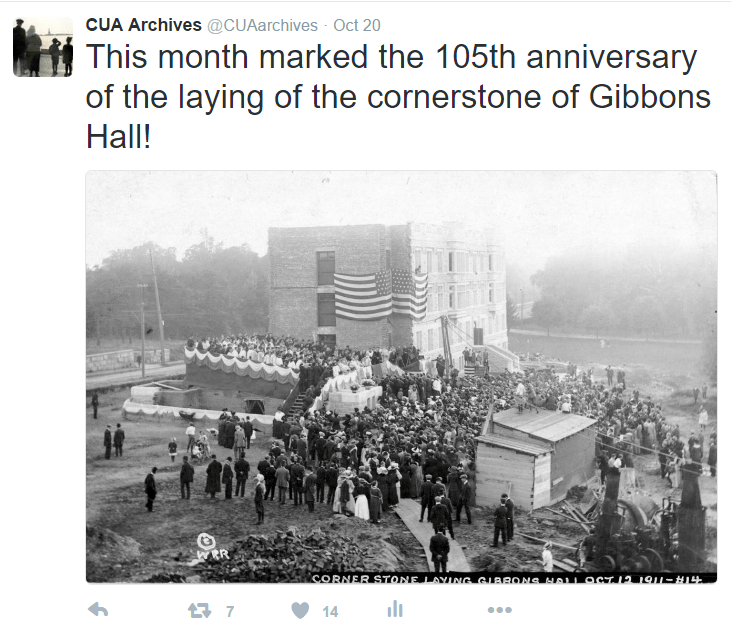
Showcase anniversaries and other dates important to your institution. Twitter post from @CUAarchives
Showcase anniversaries and other dates important to your institution. Twitter post from @CUAarchives

As the Museum Assessment Program’s Social Media Handbook explains, “Starting social media can be overwhelming, but remember that at its heart, social media is not actually about technology. Rather, it’s all about conversation and story telling. If you have a good story to share, people will want to listen and respond.” Museums, archives, and libraries have moved towards a new identity: one of dialogue, collaboration, and community. Social media plays a key role in portraying this identity, as cultural heritage institutions around the world create new narratives and two-way conversations with their audiences. By carefully evaluating their goals and resources, even the smallest archive can utilize social media to give their institution a face and personality to share with the world online.

Peruse our own social media content here:


¹Simon, N. (2009, June 9). How to develop a (small-scale) social media plan. [Blog Post]. Museum 2.0. Retrieved from http://museumtwo.blogspot.com/2009/06/how-to-develop-small-scale-social-media.html

²Kelly, L. (2009, Nov. 19). The museum’s social media strategy. [Blog Post]. Australian Museum. Retrieved from https://australian.museum/blog-archive/museullaneous/the-museums-social-media-strategy/

The Archivist’s Nook: A Labor of Love – Lantern Slides of T.V. Powderly

“Railroad Train” Lantern Slide #11

Author Katherine Santa Ana served as Graduate Library Pre-Professional (GLP), 2015-2017. A treasure trove of almost 2,000 lantern slides belonging to labor leader Terence Vincent Powderly (1849-1924) resides in our Archive. These transparent glass slides, also referred to as “magic” lantern slides, are an eclectic mix of images taken by amateur photographer Powderly as well as commercially produced images he purchased. As a native of Carbondale, Pennsylvania, Powderly incorporated many images of creeks and mountains of the keystone state – as well as the occasional coal mine – into the collection. True to his roots as a leader of the Knights of Labor, many images of industrial technology are included, especially of locomotives. There are monuments and works of art from around the world, as well as personal portraits of the Powderly family at their home in the Petworth neighborhood of Washington D.C.

Short History of Lantern Slides

To get a handle on this collection, we first look to the history of the lantern slide format and how it was used. Photographic lantern slides appeared about a decade after the invention of photography in the mid-1800s, although projectable hand painted images existed long before. At about 3.25 x 4 inches, lantern slides are physically made up of a negative printed onto a sheet of glass as a positive, transparent image. The image could then be painstakingly hand colored or matted to achieve the desired effect. Next, an additional sheet of glass was placed over the transparency, creating a glass “sandwich” to protect the surface of the photograph. Finally, the two sheets of glass were taped together, and could be inserted into a magic lantern for projection and viewing.

Lantern slides were used for two purposes: entertainment and education. The primary purpose of our USCCB Lantern Slide Collection was educational, as they accompanied presentations detailing the National Catholic Welfare Conference’s work with veterans of the First and Second World Wars in the United States. The diversity and sheer number of slides in Powderly’s collection suggest he used his slides both for entertainment and educational purposes depending on the setting. While the family portraits could have been used as the equivalent of “family home videos,” the images of industry could have been part of his work with the Knights of Labor.

These original lantern slide boxes are a little worse for wear!

Additional information on the history of lantern slides:

Taking Inventory

At some point prior to the arrival of the slides at the Archives in 2009, someone attempted to reorder the collection into simple thematic groups, such as “Stone Monuments,” “D.C. and World” and “People.” In the archival world, “respect des fonds” (preserving the original order of a group of records), is an important and fundamental principle. Often, the original order shows relationships and provides insight into how the records were accessed and used. Presumably, Powderly had his own numbered list so he could easily keep track of his collection. Since we do not have this original master list, we will be reconstructing it as we process this large collection. Going through each of the slides, we will record basic information such as the slide number and title. This is also a good time to take note of any damage the slides might have sustained.

“American Group, Albert Memorial, London” Lantern Slide #817

Rehousing

After completing the list, if we find it is more valuable for researchers to have the slides in the original order, we will reorganize them to match Powderly’s original intent. When handling the slides, we wear powder-free nitrile gloves to protect the images from fingerprints and hand oils. During this phase, we will also remove the slides from their crumbling containers and place them in archival, acid free boxes. Before doing so, each lantern slide will be carefully enfolded in a four-flap envelope to protect the surface of the image. Lantern slides are surprisingly heavy, so we place no more than 70 slides in a small box. Even then, these boxes are like bricks! As of this writing, we are a little under half way through rehousing the slides. Additional information on the housing of lantern slides:

Digitizing

Once a collection is organized and rehoused, the next question is to determine whether or not to digitize. Some questions to ask before choosing to digitize could include: Are these materials unique? Will digitization promote access to these materials? Will digitization help preserve the collection? In our case, digitization is not a high priority as many of the same images have already been scanned from prints available through the Terence Vincent Powderly Photographic Prints Digital Collection. However, should we choose to pursue digitization, many wonderful resources are available online to guide us through the process.

“Trinity College, D.C.” Lantern Slide #917

Additional information on the digitization of lantern slides:

Last Thoughts

Lantern slides are an interesting format with a rich history and a few special concerns, such as sensitivity to light, fragility, heavy weight, and need of specific housing materials. By taking a systematic approach to the various steps of the project, our large collection belonging to Terence Vincent Powderly will continue to be organized and rehoused as time and resources permit. For additional information about the life and times of amateur photographer, slide maker, labor leader, and former mayor of Scranton T.V. Powderly, check out the finding aid of his manuscript collection.

The Archivist’s Nook: A Different Aria – Opera, NBC, and CUA

Costuming prep for The Juggler
Costuming prep for The Juggler. School of Music Records, American Catholic History Research Center and University Archives.

This week’s post is guest authored by Marielle Gage, a CUA graduate student in History.

“My, how times have changed!”

Who hasn’t heard some variety of that phrase, if perhaps not in as stilted, “proper” phrasing as above? It’s often an overwrought sentiment, immediately followed by a “when I was your age…” or nostalgia of times past (that everyone complained about at the time) now seen through golden lenses. But in some cases, the sentiment is more than fair.

Take, for example, television. A hundred years ago, no one owned a television. Even thirty years later, during World War II, President Franklin D. Roosevelt relied on the radio, not television, to broadcast his “fireside chats” to the nation. And ten years after that, there were three regular channels broadcasting, one of which had no problem dedicating four Sunday afternoons to opera in the summer of 1959.

A scene from The Cage
A scene from The Cage. School of Music Records, American Catholic History Research Center and University Archives.

That’s right. The same year the Grammy Awards were first broadcasted on NBC, that same station approved the broadcasting of four one-act operas, written by and starring CUA faculty, students, and alumni, at 12:30 pm on each of the four Sundays of May. The impetus wasn’t from the higher-ups within the National Broadcasting Channel, but rather from the National Council of Catholic Men, who had a partnership with NBC to broadcast, on radio and on television, a weekly “Catholic Hour” in which presenters could explain, examine, or defend the Catholic faith. CUA’s own Fulton J. Sheen was a frequent participate in the broadcasts; he and others would expound on themes such as the Virgin Mary, racism, the last words of Christ, labor, or marriage. Perhaps wishing to change up the formula, the NCCM commissioned the four one-act operas from CUA’s music department faculty in late 1958. While a couple of different themes were suggested (the early correspondence hints frequently of a retelling of Guadalupe, but is frustratingly vague on any details, and the idea was later dropped), the final four operas were: Dolcedo, the last day of an atheistic philosopher now in the care of nuns (music by Emerson Meyers, libretto by Dominic Rover, O.P.); The Cage, the story of an elevator operator who desperately wishes to travel, but feels trapped caring for his invalid and verbally abusive mother (music by George Thaddeus Jones, libretto by Leo Brady); The Decorator, a glimpse into the life of a middle-class mother trying so hard to be fashionable (music by Russell Woollen, libretto by Frank and Dorothy Getlein); and The Juggler, a retelling of the “clown of God” legend (music by William Graves, libretto by Arch Lustberg).

Filming Dolcedo. School of Music Records, American Catholic History Research Center and University Archives.

While none of the operas, perhaps, are must-see classics (The Decorator, in particular, is a bit heavy-handed), it still must have been an adventure for the CUA students who participated and watched the productions. Unfortunately, little remains of any publicity or retrospectives within the CUA community concerning the operas. The surviving letters and photographs, then, remain a tantalizing glimpse at a curious moment in CUA’s musical history, and of American cultural history in general, from a time when it was not inconceivable that a portion of the American population would choose to spend their Sunday afternoons watching opera.

The Archivist’s Nook: Best of the Museum Collection on Campus

Ivory Triptych Date of Gift: 1917 Location: McMahon Hall – Room 109
Ivory Triptych
Date of Gift: 1917
Location: McMahon Hall – Room 109

Author Katherine Santa Ana served as Graduate Library Pre-Professional (GLP), 2015-2017.

Here at the Archives, keeping track of the many museum worthy art objects on The Catholic University of America campus is perhaps one of our lesser known duties. While we have written extensively about the history of the museum collection as well as several specific objects in the collection, we have long wanted to take you on a grand tour of the “Best of the Museum Collection on Campus.” It was difficult to narrow down which stops to include on this tour as there are so many treasures to find, but we selected a few of our favorites!

We’ll start at the second oldest campus building, McMahon Hall, which was dedicated in 1895 by Cardinal James Gibbons. Walking inside the foyer, one of the most iconic museum pieces at CUA is hard to miss: the heroic statue of Pope Leo XIII seated on a throne. Crowned with a tiara, the Holy Father is raising his hand in a gesture of blessing. The gift of Joseph F. Loubat, the statue was made from Carrarra marble by Guiseppi Luchetti. This statue was famous in its day; Theodore Roosevelt himself rode over to pay it a visit! In front of this imposing, 12 foot tall statue is a massive marble table, a more recently acquired museum piece whose fascinating history is told in a previous blog post.

St. Paul and Madonna and Child Statues Date of Gift: 1959 Location: Mullen Library – May Gallery
St. Paul and Madonna and Child Statues
Date of Gift: 1959
Location: Mullen Library – May Gallery

Now it’s time to make your way down the hall to room 109, the School of Arts and Sciences. In the main seating area, you’ll find a large ivory relief triptych depicting multiple Gospel scenes. Given to CUA in 1917 by Arthur Connolly, this work of art was completed in 17th century France. Ivory triptychs are rarely found at this scale, this one is unusual for its large size. Among the stories of the life of Christ told through the carved panels, you’ll find many Gothic motifs, such as elaborately carved pointed arches.

Our next stop is Caldwell Hall, the oldest building on campus. Walking through the front doors, you’ll ascend the sweeping staircase and enter Caldwell Chapel. An entire museum piece in its own right, this chapel is also home to seventeen, “Munich style” stained glass windows completed by the Royal Bavarian Art Institute between 1888 and 1890. Exiting the chapel, walk down the hall to room 111. This inconspicuous classroom is home to one of a pair of paintings given to the university in 1961 by Antony Pisani. This 126 inch long oil painting depicts the “Hunting of the Meleager,” a heroic legend of Meleager, Atalanta, Jason, and others hunting the Calydonian boar. This painting and its pair, “Dance of Nymphs” located in the third floor hallway of Caldwell, correspond to two famous paintings by Nicolas Poussin: “The Hunt of Meleager” of the Prado and “Dance in Honor of Priapus” of the Sao Paulo Museu de Arte.

Our last stop in Caldwell is on the first floor, in room 100. Known as the Monsignor Stephen P. Happel Room, this space is home to a large oil painting attributed to the Spanish Baroque artist Bartolomé Esteban Murillo. Donated in 1926, this painting was originally thought to depict St. Francis of Assisi carrying a cross. However, in recent years we have come to believe it may be San Diego de Alcala, as Saint Francis is usually shown as an older, bearded man.

“Dance of the Nymphs” Oil Painting Date of Gift: 1961 Location: Caldwell Hall – 3rd Floor Hallway
“Dance of the Nymphs” Oil Painting
Date of Gift: 1961
Location: Caldwell Hall – 3rd Floor Hallway

Let’s end our museum tour in the John K. Mullen of Denver Memorial Library. While this library is home to many statues and works of art, we’ll highlight just two in the May Gallery of the first floor. This gallery displays two French Gothic wood statues on either side of the fireplace. On the left, you’ll find a late 14th century statue of St. Paul, donated by a Miss Jesse Jebiley. On the right is a 13th century Madonna and Child, donated by Frederick Jambes. They make a wonderful pair to finish off our tour with!

For any questions about the museum collection, send us an email at lib-archives@cua.edu. For an easy to print list of all the items mentioned in this post, follow the link: Best of the Museum on Campus List

The Archivist’s Nook: Digital Collections and Copyright – A Tough Boat to Swallow

Fair use? You decide.

The following post was authored by Digital Archivist Paul Kelly.

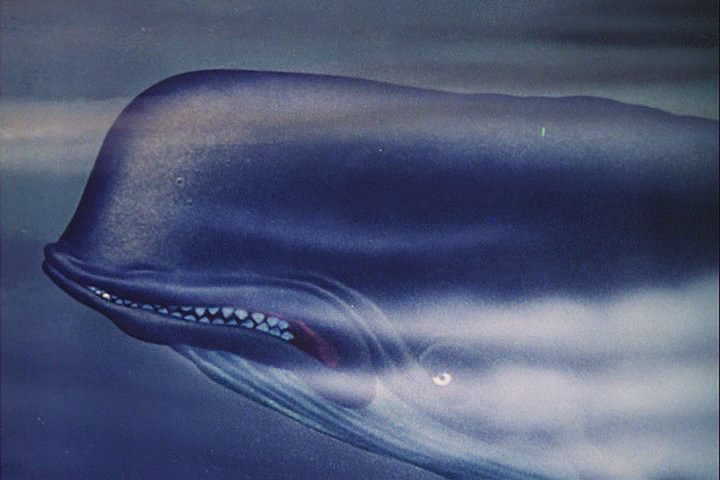
Let’s do a quick exercise. Think back to your last Google image search. Can you remember what you were searching for? Can you remember the reason you were looking?  Can you remember what you found, and how you used it? I’ll go first. According to my search history, around 2 weeks ago I conducted a hunt for images of Monstro the Whale from Disney’s 1940 animated adaptation of Pinocchio. I’ll keep the reasons to myself, but you can see one of the results for yourself in this blog post. Final question – did you happen to investigate the copyright status of whatever you found? I’m betting not, and you’re far from alone. I certainly didn’t, and I know that you can filter results by usage rights. What’s my excuse?

Although copyright law as a subject cannot possibly be covered in a single blog post, we can go over some basic history. According to the US Constitution, the original purpose of copyright in the United States was to “promote the progress of science and useful arts by securing for limited times to authors and inventors the exclusive right to their respective writings and discoveries.” While the laws governing copyright have evolved over time (sometimes at the lobbying behest of our old friend The Walt Disney Company), that core principal, in theory, has not changed. Continue reading “The Archivist’s Nook: Digital Collections and Copyright – A Tough Boat to Swallow” →

The Archivist’s Nook: Meticulous Mittmen – CUA Boxing and the Undefeated 1938 Season

Boxing Team Drills
Boxing Team Drills. CUA Athletics Department, American Catholic History Research Center and University Archives.

This week’s post was written by Dallas Grubbs, a graduate student in History.

More than four thousand people pack into the gym in what is now the Crough Center Architecture building. The gentleman are dressed in black tuxedos, the women in fine silk dresses. Murmurs of excitement fill the hall. These spectators have arrived more than two hours early to ensure their place at this most recent performance of “Eddie’s boys.” “Eddie’s boys,” by the way, are not an all-male a cappella group. They are, in fact, the fiercest boxers on the east coast.

The year is 1938. The decade has witnessed the rise of CUA’s “mittmen” to dominance under the tutelage of coach Edmund “Eddie” LaFond, who has guided his teams to almost forty wins in their last fifty bouts. These bouts, composed of three two-minute rounds, were undoubtedly the longest and most punishing six minutes in the lives of those lads who had to compete against “Eddie’s boys” in the packed arenas. Yet despite their successes, two goals continue to elude LaFond and his punishing pugilists. The first is an undefeated season. The second, an NCAA boxing championship. The year is 1938. And this year LaFond and his boys have decided that they’re going to have both. Continue reading “The Archivist’s Nook: Meticulous Mittmen – CUA Boxing and the Undefeated 1938 Season” →

The Archivist’s Nook: The World is My Parish – James Magner

MagnerAd_1958
Advertisement for tour through Mexico and Guatemala, 1958.

Author Katherine Santa Ana served as Graduate Library Pre-Professional (GLP), 2015-2017.

One particular character looms large at the American Catholic History Research Center and University Archives: the Rev. Msgr. James Magner (1901-1995). Born in Illinois, he attended Saint Mary of the Lake Seminary, was ordained in 1926 and completed his higher education in Rome at the Urban College of the Propaganda Fidei and the Academy of Saint Thomas Aquinas. Magner joined The Catholic University of America community in 1940, where he held many roles over the years including Assistant Secretary Treasurer, Director of the University Press, and Vice Rector for Business and Finance, as well as occasionally lectured. Retiring in 1968, he gave 28 years of service to the University.

That short biography fails to encompass the wide-ranging interests and hobbies of this unique – dare I say quirky – priest. An avid traveler and collector, the Archives received his estate in 1995, including many museum objects brought back from abroad. As Magner explained in his memoirs, “Travel has been among the most rewarding experiences of my life. I have regarded it, not merely as a holiday or change from my regular occupations, but really an opportunity to broaden and deepen my knowledge of the world and its people.” His lifelong love of travel began in the 1930s, as he explored Mexico. In the 1940s, Magner began organizing and leading seminar group tours of Mexicopage 4 for Catholic University students. Today, the Archive’s Magner Museum Collection includes over one hundred Pre-Columbian objects brought back from Mexico and several other Central and South American countries, a selection of which are currently on display in the Archive’s reading room.

A page from James Magner’s collection of Soviet stamps.

In the 1950s, Magner expanded his travels and tours to all over the world. In July of 1951, he conducted a world tour utilizing the latest exciting development in commercial travel: the airplane. As he explains in his memoir My Faces & Places Volume II, 1929-1953:

“I undertook this tour around the world by air, as something of a stunt, but it turned out to be one of the most exciting and educational experiences in my life. It was like a review of the history of the great cultures of the world compressed into a page. I truly felt that I have gone Jules Verne one better.”

Upon his return, Magner gave a lecture, “Around the World in Forty Days”, on his experience. This lecture gives a tantalizing glimpse into the politics and headlines of the time, including the rising tensions in Palestine and between Pakistan and India.

Riding an elephant in India, 1978.

By the 1960s, Magner had added quite the roster of countries to his summer tours, including many under the sway of the Soviet Union. Magner had personally been traveling within the Soviet Unionpage 3 and the Eastern Bloc since 1956. When asked why he made these daring trips, he explained he wanted to see for himself what was going on behind the Iron Curtain. These excursions occurred largely without incident, with one exception. Prior to his 1965 tour of Czechoslovakia, Poland, Russia, Ukraine, Romania, Bulgaria and Yugoslavia, the Polish consular office initially declined to give Magner a visa. According to Magner, “apparently they feared that I might be on a secret mission or wondered why a Catholic priest had to go with the group.”

James Magner, priest, scholar, collector, traveler, and university administrator, retired to West Palm Beach, Florida in 1968. Not one to sit ideally by even if retired, he served two parishes in the area as a visiting priest, wrote his memoirs, and continued to amass a collection of books, art and artifacts. December 30, 1994, Rev. Msgr Magner passed awaypage 4 at the ripe old age of 93. He shared his experiences abroad not only with those he brought on his tours, but also the many attendees of his lectures where he often shared films of his travelspage 3. His legacy lives on at the Archives through his personal papers and museum objects as well as his donation of the historically significant Iturbide-Kearney Family Collection. On The Catholic University of America campus, a building bears his name in the Centennial Village residential community.

The Archivist’s Nook: Provoking the Canon – Moog, Meyers, and Experimental Music

Emerson Meyers
Emerson Meyers

The following post was authored by Digital Archivist Paul Kelly.

In honor of Moogfest, next week’s fantastic electronic music/art festival in North Carolina (that I wish I was going to), this month I wanted to highlight some CUA connections to not only early electronic music, but also to Bob Moog himself, the inventor of the legendary synthesizer, and the person after whom Moogfest is named.

Would you believe that CUA was once a pioneering institution for experimental music? Founded in 1961 by Professor Emerson Meyers, the university’s Electronic Music Laboratory housed the most state-of-the-art recording equipment of the time, including one Moog synthesizer. This particular unit was one of the first manufactured; indeed, the School of Music was so eager to procure one that official manuals were not available at the time of purchase. How, then, did they figure out how to operate what was then a completely new kind of instrument? They wrote directly to Moog, who replied with pages and pages of technical instructions and hand-drawn diagrams that we still have here at the Archives. Faculty then used these documents to create in-house manuals for the equipment in the studio. Continue reading “The Archivist’s Nook: Provoking the Canon – Moog, Meyers, and Experimental Music” →

The Archivist’s Nook: Stirring the Irish Cauldron

“The Cork Landlords Stirring up a Devil’s Cauldron.” United Ireland, October 3, 1885. From the Irish Home Rule Political Cartoon Collection, American Catholic History Research Center and University Archives.

This week’s post is guest authored by Marielle Gage, a CUA graduate student in History.

Saint Patrick’s Day is a beloved holiday, but for many Irish-Americans their heritage intersects with their daily lives more than once a year. Whether you grew up amused or irritated by a certain cereal leprechaun, or found that friend who couldn’t tell the difference between a Mc- and a Mac- adorable or infuriating, life as an American of Irish descent is filled with constant awareness. Or, at least, my own has been. I think I knew about the Potato Famine before the American War of Independence, and I still have an instinctive, furious reaction if anyone ever dare suggest that Oliver Cromwell ever did a good thing in his life.

Interest (as well as pride) in Irish heritage and history is nothing unique or special about me; it has a long and rich tradition in the Irish-American community. Here, at the American Catholic History Research Center and University Archives, we house several historical collections directly dealing with Irish and Irish-American history. A particularly fun collection is the Ancient Order of the Hibernians (founded 1836), but in deference to the 100th anniversary of the Easter Rising, a seminal moment in the march towards an autonomous Irish state, I will direct your attention to our various exhibits in honor of Irish Independence.

Prison Pass, April 6, 1869. Thomas C. Luby Papers, American Catholic History Research Center and University Archives.
Prison Pass, April 6, 1869. From the Thomas C. Luby Papers, American Catholic History Research Center and University Archives.

First, we have our physical exhibit, organized by our wonderful Katherine Santa Ana, “Sworn to Be Free: Irish Nationalism 1860-1921,” currently on display in the May Gallery of Mullen Library (first floor). The exhibit shows a selection of items from our holdings: letters, Gaelic alphabet cards, political cartoons, photographs, medals, and more. “Sworn to Be Free” looks at the cause of Irish Independence from an American Irish viewpoint: some of our records come from Irish immigrants, but most come from first or second-generation descendants who still maintained keen affection and concern for their motherland. When the struggles for independence became fraught, Irish republicans often looked to their American brethren for material, intellectual, and spiritual support, and the exhibit highlights several Americans offering that support. For those unable to visit “Sworn to Be Free” in person (and if you can, you really should), there is an online version of the exhibit available.

United Irish League of America 5th Biennial National Convention Delegate Ribbon, September 7-28, 1910. From the Terence V. Powderly Papers, American Catholic History Research Center and University Archives.

To complement the online exhibit,  we are offering a document-based online exhibit, “Exploring Irish Nationalism with ACUA: An Academic Resource”, for use of teachers, students, and the interested public who might wish to explore Irish independence (and CUA’s connection to it) deeper. Offering certain, select examples from the James Aloysius Geary Papers and the Thomas J. Shahan Papers, both housed at ACUA, this second online exhibit is intended to provide background for the Easter Rising and later War of Independence. Included in Geary’s papers, for example, are minutes and publications of The Friends of Irish Freedom, an American group that watched the Rising and subsequent events with great interest. Shahan preserved several issues of the Irish Bulletin, a publication of the Irish State during the war with Great Britain which often dedicated its pages to illustrating the crimes the English had committed against the Irish people. Impartial news it may not be, but they do serve as a reflection of very real opinions and attitudes present both in Ireland and in sympathetic Irish-Americans.

Neither exhibit is — or claims to be — the whole picture of Irish nationalism and Irish-American sympathy with it. But we have tried to highlight interesting individuals, events, and organizations. We hope our exhibits will not be the end of your curiosity, but the beginning.

The Archivist’s Nook: A Montana Missionary – His Life and Teeth

E.W.J. Lindesmith
E.W.J. Lindesmith

Author Katherine Santa Ana served as Graduate Library Pre-Professional (GLP), 2015-2017.

Since 1982, the Knights of Columbus Museum of New Haven, Connecticut has told the story of their fraternal organization’s history and Catholic heritage through the display of art and artifacts. From April 9th through September 18th of 2016, visitors can view “Mission of Faith: The Coming of the Gospel to America,” an exhibit featuring the missionaries who explored and evangelized the North American continent. The American Catholic History Research Center and University Archives here at The Catholic University of America contributed several objects to this exhibit, including mission tiles painted by the Sisters of Mercy in mid-19th century California, as well as items belonging to the intrepid Reverend Eli Washington John Lindesmith (1827 – 1922), a missionary and military chaplain stationed in the late 19th century at Fort Keogh, Montana. Check out the previous blog post, Sisters of Mercy Mission Tiles, for more details on the history and travels of our California mission artifacts.

This exhibit at the Knights of Columbus Museum gives us the opportunity to take a look at one of the Archives’ most dynamic and verbose characters, E.W.J. Lindesmith. As our History of the Museum Collection explains, he collected objects from the Sioux and Cheyenne, as well as preserved artifacts from his own life as a chaplain to soldiers of the Indian Wars (from altar stones and altar cards to his own extracted teeth!). With an eye to the future, he meticulously recorded his own stories and reflections to accompany each object.

Some of Lindesmith’s teeth and the Colgate & Co. Shaving Stick canister he saved them in.

One broken slate altar stone, currently on loan to the Knights of Columbus Museum exhibit, was given to Lindesmith by another Montana missionary. Why save a fragmented stone with a travel stained and ripped cover? According to Lindesmith:

“This stone was carried over many thousands of miles among whites, indians, soldiers, trappers, miners, explorers, and frontiersmen of every kind, on cars, boats, stages, and even muleback, and often afoot through almost impenetrable mountains, bluffs, coulees, rooks, canyons, forests, badlands, prairie and over rivers without bridges. — at all hours by day and night — not knowing at what minute they might fall into the hands of road agents or hostile indians by mistake.”

His reasoning for saving his pulled teeth is a bit briefer, but to the point: “I want to show the dentists some of their good work and some of their bad work.”

Perhaps the objects carried by Lindesmith for the longest time are his altar cards. These three simple cards are memory aids placed on the altar during mass for easy reference to prayers. Purchased in 1855, Lindesmith used them to practice celebrating mass as a seminary student and went on to utilize them for fifty-two years on all of his mission stations. Noting their stained and time-worn appearance, he explained: “Long ago I could have got better cards, but these were handy and I was attached to them and would not exchange them for the best that could be got.”

One the altar cards Lindesmith carried for fifty two years.

More of Lindesmith’s writings can be found in our digital exhibit showcasing his sermon notes on topics ranging from temperance to women’s rights, while additional biographic information is available in the finding aid to his personal papers. Through participating in the Knights of Columbus Museum’s exhibit, we hope to give a broader audience a glimpse into the vibrant life of this missionary, military chaplain, and frontiersman through the objects he carried.